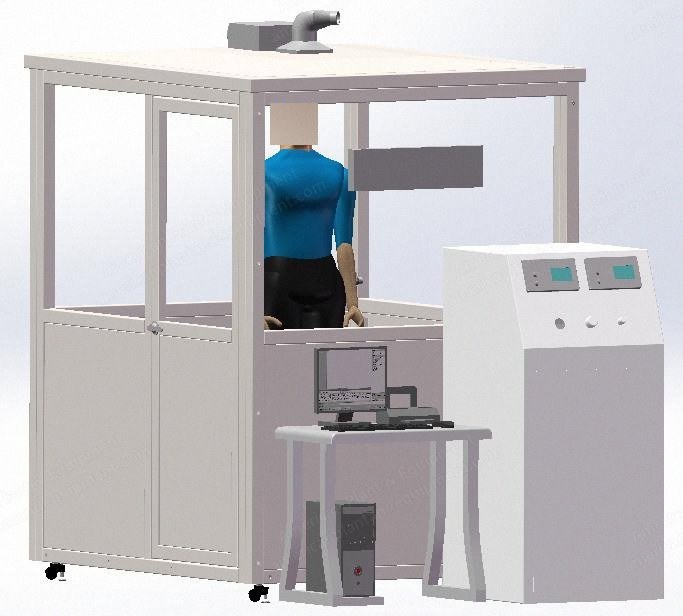
Used to test the overall protective performance of solid particulate chemical protective clothing.
The performance index of protective clothing is characterized by the leakage rate of chemical pollution of particulates into the clothing in the workplace environment.
Technical requirements for GB 19083-2010 medical protective masks appendix B adhesion.
Principle
A standard aerosol of NaCl particles is generated by an aerosol generator and enters the test room to maintain a relatively stable state.
The test subject wears the test protective clothing to perform a test action according to a predetermined plan in the test room.
The aerosol concentration of NaCl particles in the protective clothing under test was measured at the sampling point.
The overall protective performance of the protective clothing against particulates was evaluated by the following indicators: single inward leak rate at each sampling location LIJM, total inward leakage rate of each protective clothing tested LS, total inward leakage rate of each measured object LH, total inward leakage rate for each test action LE, total inward leakage rate at each sampling location LP, average total inward leakage rate L.
Relative Standards
GB/T 29511-2013 protective clothing chemical protection clothing for solid particulate matter 4.3.1 and appendix A.
GB 2626-2019 respirator self-absorption of filtering particulate respirators section 6.4 technical requirements for medical protective masks appendix B adhesion.
Standard like ISO 13982, BS EN ISO 13982, EN 1073-1-2016.
Standard contrast: sampling procedure of the standard GB/T 29511-2013.
Sampling procedure of the standard EN 1073-1-2016.
Difference between GB/T 29511-2013, GB2626-2019 and EN 1073-1-2016: sampling points on test chamber (GB/T 29511-2013 single point of overhead, GB2626-2019 single point of overhead, EN 1073-1-2016 three points overhead, waist, knee); sampling points on test cloth (GB/T 29511-2013 three independence chest, waist, knee, GB2626-2019 one area of breathing, EN 1073-1-2016 together with one chest, waist, knee one area of breathing, when body parts are sampled air is replenished on the back); sample method (GB/T 29511-2013 when one place is sampled one of the other two places is replenished, GB2626-2019 sample only, EN 1073-1-2016 breathing area sample when inhaling and fill the air with photometer when exhaling determined by pressure test).
Technical Data
Test environment requirements: ambient temperature (20 ± 5) °C, relative humidity ≤ 60%.
≥ 4000 × 5000 × 3000 mm using room, inlet and drainage, good ventilation.
System parameters: effective internal size 1800 mm × 1500 mm × 2100 mm (L × W × H); size of out test room 1950 mm × 1650 mm × 2500 mm (L × W × H); size of control container 700 mm × 700 mm × 1600 mm (L × W × H).
Environmental simulation detection system: NaCl particle aerosol generator with particle aerosol concentration (10 ± 1) mg/m³, aerodynamic particle size distribution of particulate matter (0.02–2) mm, mass median diameter about 0.6 mm, effective variation of the room concentration ≤ 10%, occurrence ≥ 100 L/min.
2 pcs particle concentration detector with dynamic range (0.001–200) mg/m³, precision ± 1%, response time ≤ 500 ms.
Horizontal pedal drive test-bed operation speed (5 ± 0.5) km/h.
Air duct circulation and maintenance of cleaning equipment.
Control Analysis System
Centralized console, PC computer programmed control and prompt to complete the whole process of the test.
Automatic monitoring of test data, automatic calculation of experimental single internal leakage rate, total inward leakage rate, average total inward leakage rate and other experimental results, and output of experimental results in multiple ways.
Correlation Traceability Index
Particle aerosol generator: the air volume is not less than 100 L/min, and the concentration of NaCl aerosol (10 ± 1) mg/m³ is ≤ ± 10% in the effective space of the test chamber; the aerodynamic particle size distribution of particles should be (0.02–2) mm, and the mass median diameter is about 0.6 mm.
Particulate detector: two detectors were used to detect the concentration of NaCl aerosol particles in the test room and the protective clothing respectively; the dynamic range is (0.001–200) mg/m³, the precision is ± 1%, and the detector's response time is ≤ 500 ms.
Horizontal pedal drive test-bed: 1 pc, the operation speed is (5 ± 0.5) km/h, install inside of the test room.
Sampling pump and air line: 2 pcs are used to collect NaCl aerosol in the test room and the protective clothing; flow range (0.05–4) L/min, flow fluctuation < ± 0.2 L/min; it can ensure that the sampling probe can sample at a flow rate of (2 ± 0.5) L/min inside the protective clothing under test; in order to ensure that the reduced pressure generated by sampling in the protective clothing under test does not cause an additional inward leakage rate, it should be delivered in the sampled colleagues at a rate of (2 ± 0.5) L/min to the protective clothing under test; clean air can be fed to one of the two other sampling probes in the sampling interval according to the sampling sequence of the schematic.
Sampling probe: there were 4 sampling probes, one of which was used to detect the concentration of NaCl aerosol particles in the environment of the test room, and the other 3 were used to measure the concentration of NaCl aerosol particles in the protective clothing under test; the sampling probe is connected to a transparent plastic tube with an inner diameter of 4.0 mm and an appropriate length.
Request a Quote
✓
Request sent
Thank you, our team will reply to you shortly.
Direct access to our team
Email American Plant & Equipment
Tell us what you want to buy, source, finance, or sell. A machinery specialist will follow up with you.
✓
Thank you. Your request is with the American Plant and Equipment team.
A machinery specialist will follow up with you.
Machinery updates
Subscribe to our email list
Tell us which industries you follow and we will send you the machines that match.
✓
You are on the list.
We will email you when machines that match your interests come in. Unsubscribe from any message.