GCM, 50 H, Roll Packing Machine, 2400mm Max Roll Width, 60 Rolls/Hour
Scroll to zoom
100%
Description
Overview
50 H
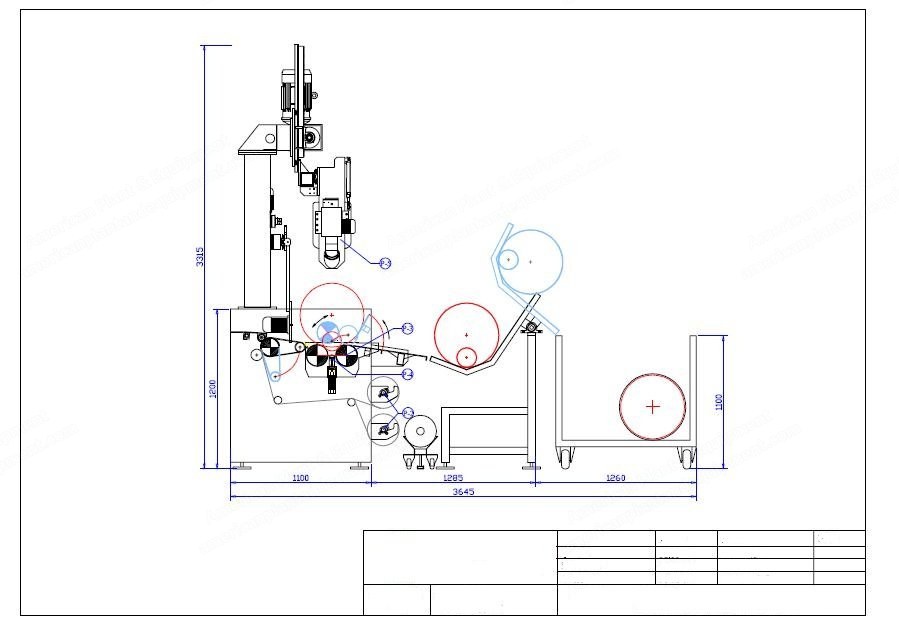
General processes: Operator places the roll on the inlet board; the roll's open edge is rolled until it reaches the edge of the film rolling cylinders, then unrolled with fabric flowing down.
During forward rotation, nylon film feeds and winds onto the roll between the fabric.
After enough nylon film is rolled (max 2 fold), the film is cut and stuck onto the roll.
Hot air is insufflated at both edges of the fabric, and the puckered nylon film is pressed to the frontal area of the roll.
The finished roll is transferred to a lever board and bowled to the dispatching carriage by lifting the board.
All processes from loading the roll to the nylon rolling board to bowling to dispatch are realized automatically.
Specifications
Roll width: min. 1,000 mm – max. 2,400 mm
Roll diameter: min. 150 mm – max. 500 mm
Weight of roll: max. 100 kg
Max. nylon width: max. 3,000 mm
Nylon thickness: 60–120 micron
Packing capability: 60 rolls/hour
Packing Tray (P-3)
The roll on the weight tray is bowled over to the packing tray with one edge open.
Operator loads the fabric roll with one edge open and bowls it onto the rolling cylinders.
Fabric stays on the board during rotation; the open edge of the roll comes to the cylinder edge, and a few fabric pieces flow down from the cylinder edge.
Nylon Feeding (P-2)
The packing nylon is placed at the back side of the roller unit and carried to the rolling area by the operator.
Nylon film is pulled by the conveyor band and transferred to the packing tray.
Nylon feeding and fabric rolling processes occur simultaneously.
The nylon film's edge is placed between the fabrics and rolled onto the roll.
Nylon film is cut after sufficient rolling according to diameter.
Width Welding (P-4)
The cut edge of the nylon film is rolled a few times onto the fabric roll.
The welding jaw rises between the roller cylinders, contacts the roll's surface from end to end, and welds the nylon film folds to each other.
Edge Closing (P-5)
Nylon film on both sides of the roll is puckered by hot air and pressed to the frontal area of the roll.
Hot air insufflation is done by two different blowers with thermal springs.
The blowers move up-down and left-right according to the diameter and length of the roll.
As the roll rotates on the cylinders, the air blowers come closer to the edge of the roll and pucker the nylon film with heating.
In this blower process, two units of Leister mark Vulcan <E> model 10 kW heat air blowers are used.
Emptying
The roll is bowled onto the lever board by the roller cylinder leaning to one side.
The emptying board's level form transfers the roll onto the dispatching carriage.
Motor Power
Nylon feeding and rolling group: 0.37 kW – 1400 rpm (50/60 frame), 2 units.
Blade motor: 24 volt DC, 1 unit.
Insufflations system vertical movement: 1.1 kW – 1400 rpm (75/50 frame), 1 unit.