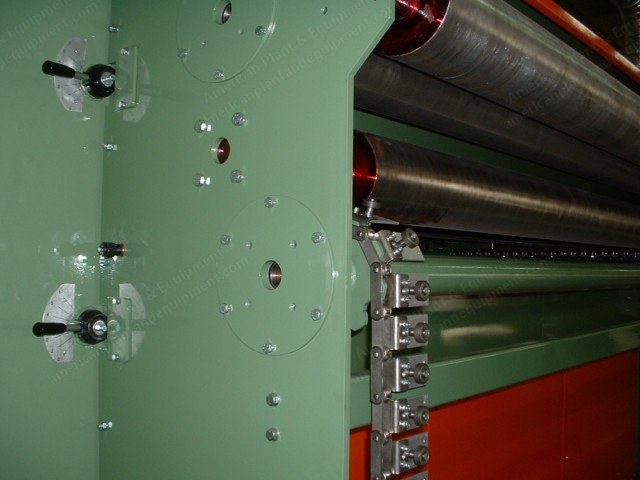
Mecatex, Drying Oven for Geogrids, 3800mm, 200C, 1 Heating Section
Scroll to zoom
100%
Description
Overview
Machine suitable for drying of resins that require a time of exposure to heat no more than 1 minute and with a maximum temperature of 200°C.
Working width: 3800 mm.
Machine speed: up to 1 meter (others upon request, but will change the side and features of the oven).
Maximum speed of the offered oven is equivalent to 1.1 metres per minute.
The machine is designed to work in line with the geo-grid forming machine (weaving loom) and the dried product winder.
The speed of the machine depends on the exit speed of the weaving loom.
Composition
Oven 1 heating section.
Heating media: GPL / natural gas.
Heating capacity installed: 1 burner, 35-200 kW.
Circulating air volume: 1 x max. 15000 cubic metres/hour, adjustable by inverter.
Max air temperature: 200°C.
Compressed air requirement: 6 bar.
Installed electric power: approx. 20 kW.
Components
Feeding cylinders, governed by geared-motor with inverter for the speed regulation.
Lateral stainless steel chains, provided with small needled plates for the transportation of the material (geogrids). Distance between chains is adjustable, to compensate the shrinkage of the material being processed.
Alternating slot nozzles to blow the hot air directly through the material from both sides.
Gas burner.
Recovery cylinders (at the exit), governed by geared-motor with inverter for the speed regulation.
Supply air fan.
Exhaust fan.
Smoke extractor fan.
Electric control panel.
Impregnation System
Stainless steel tank.
PVC level control.
Lick roller.
Squeezing unit, composed of 2 cylinders controlled by a pneumatic system.
Possibility to lower the stainless steel tank, to allow cleaning and maintenance operation.
A device for the resin level control is installed inside the tank. Said device enables/disables the feed pump (said pump is not included in the supply).
Operation Details
The machine is equipped with a tank for the containment of the resin to be applied to the geo-grids.
Once impregnation is effected, the geo-grid is brought inside the oven by means of two lateral chains equipped with needled plates.
From the entry towards the exit of the oven, the distance of these chains can be enlarged of about 100 mm, in order to contain the shrinkage of the geo-grid during the drying phase.
At the exit point of the oven, the material is removed from the needled plates of the chains, by means of two cylinders on which the material itself is wrapped in the form of S.
A counter is mounted after the two recovery cylinders. Said counter is settable, in order to establish the length of the dried and impregnated rolls of material to be realized.
The rolls diameter is variable and depends on the movement means (fork lift) that you have available (larger diameter = more weight). However, diameters which allow to optimize the loading of trucks are always realized.
When the pre-set working temperature set point is reached and if the resin level into the tank is correct and if no alarms is active, the oven sends the “machine ready” signal to the weaving loom.
The weaving loom cannot be started if no consent from the oven arrives.
Once the consent is received and if no alarm is active, the weaving loom starts running and simultaneously sends the run command and the speed reference to the movements of the oven.
If the weaving loom is stopped for any reason, you also stop the movements.
The material in exit from the weaving loom is fed to the impregnation tank.
After impregnation, the resin in excess is eliminated by a couple of squeezing rollers.
After squeezing, the material is hooked to the needled plates of the lateral chains that drags it inside the oven.
The device ensures the right tensioning of the material between the exit of the weaving loom and the entry point of the oven, by self-adjusting the speed of the movements.
Shortly before reaching the established length of the roll (on the winder), a beep sound alerts the operator that the roll must be removed to start a new one.
Request a Quote
✓
Request sent
Thank you, our team will reply to you shortly.
Direct access to our team
Email American Plant & Equipment
Tell us what you want to buy, source, finance, or sell. A machinery specialist will follow up with you.
✓
Thank you. Your request is with the American Plant and Equipment team.
A machinery specialist will follow up with you.
Machinery updates
Subscribe to our email list
Tell us which industries you follow and we will send you the machines that match.
✓
You are on the list.
We will email you when machines that match your interests come in. Unsubscribe from any message.