Pillow Filling Line, with Automatic Sewing, 120 kg/h Capacity
Scroll to zoom
100%
Description
Overview
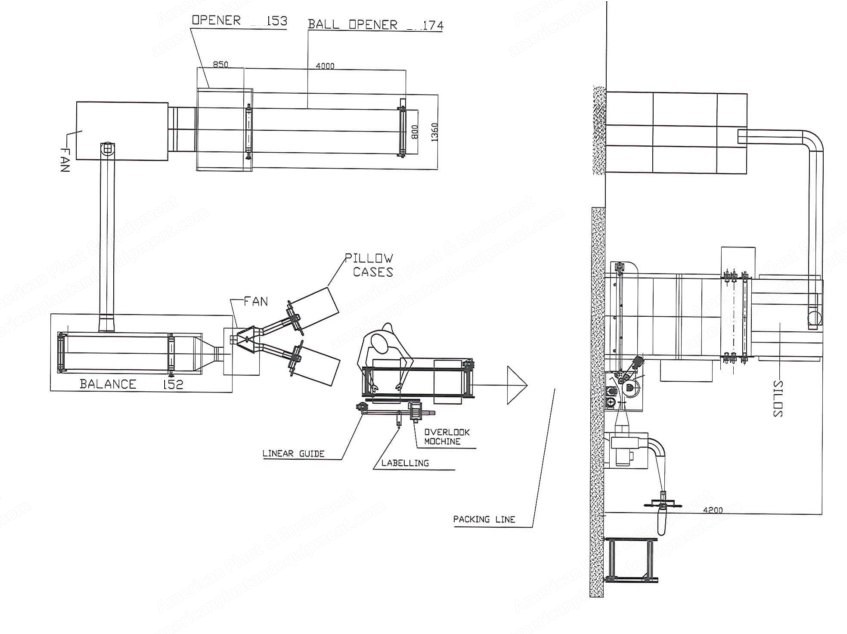
The line is composed of a bale-opener model 174, an opener machine model 153, and a loader with balance group model 152.
Upstream the automatic pillows line, it is possible to install a bale-opener allowing to fill automatically the opener model 153.
With reference to the filling and sewing of the open side, it is possible to proceed with two solutions: solution 1 (filling station with automatic overlook sewing group) or solution 2 (manual filling station and automatic overlook sewing group).
Bale-Opener Model 174
Sturdy steel structure on which a first motorized-conveyor is mounted, carrying the raw-fiber bale to a second motorized-conveyor, supplying a riveted-carpet that transports the raw fibre, making it fall on the entrance-conveyor of opener BM153.
A dosing reel batches the quantity of fibre to be processed.
A second reel detaches the fiber, making it fall on the opener entrance-conveyor.
Dimension: height = 2200 mm, width = 1000 mm, length = 3000 mm.
Power: as per customer.
Electric consumption: 3 kW.
Opener Machine Model 153
Feed conveyor group: the operator manually deposits the chunks of the fiber to be opened on the feed conveyor that feeds the opener machine.
Lined cylinder group: open the chunks of the fiber with a carding action.
Aspirator group: sucks the opened fiber or chunks from the lined cylinders group and conveys them by air to the silo.
Dimension: height = 1300 mm, width = 1300 mm, length = 3700 mm.
Electric power: as per customer.
Electric consumption: 12 kW.
Capacity of the machine: about 120 kg/h of polyester tuft.
Loader With Balance Group Model 152
Welded carbon-steel structure.
Feeding silo: accumulates the opened fibers in order to guarantee a continuous working without interruptions; the regular filling of the silo is controlled by photocells; three pairs of rolls proportion the opened fibres coming from the silo (first pair composed of two stellar-rolls, second pair by two tamper-rolls, end by two catcher-rolls).
ASPO group: composed by one spiked roll that takes the fibers from the catcher-rolls and feeds them into the balance.
Electronic balance group: made of aluminium and is suspended to 4 loading-cells; an electronic program controls that the weight set by the operator is exactly reached; tolerance +/- 20 gr; it is possible to program the balance in order to execute consecutive weighings with different weights; this system allows to fill pillows for sofas composed of different pockets of different weights.
Exit conveyor and fan group: after the correct weight has been reached, the balance opens and the fibres drop on the underlying conveyor that starts moving; the fan group positioned after the belt sucks the fibres and blows them inside the pillow-bags.
Dimension: height = 4000 mm, width = 1400 mm, length = 3500 mm.
The compressed-air must be dry, without humidity; pressure: min. 3 bar, max. 6 bar; consumption of compressed air for any draft: 2 normal liters.
Electric power: 380/400 V, 50 Hz.
Electric consumption: 13 kW.
Capacity: about 45/50 pillows/hour.
Dimensions: 50 x 60 h = 25, weight 1800 gr.
Can be programmed to make different weightings and fill pillows composed by multiple bags.
Solution 1: Filling Station With Automatic Overlook Sewing Group
It is fixed in exit of the loader model 152 and allows to automatically fill the pillow-cases with the pre-set quantity of fiber and automatically convey it to the overlook machine for the final sewing of the open side.
Single exit filling unit: to fill the pillowcase with the fiber, the machine is equipped with one exit filling pipe connected to the loader; in this position the operator has to manually insert the fabric cover on the pipe and presses the control pedal: the pneumatic gun closes and automatically stopped the pillow-case on the pipe until the end of the filling phase.
Conveyor-belt group with linear guide: at the end of the filling phase the pipe moves back in "0" position, the linear guide closes and the pneumatic gun opens; the linear guide starts, moving the pillow through the overlook sewing machine.
Overlook sewing unit: composed by an overlook Pegasus machine to close the open side of the lining and by a labeling group to sewing the label on the lining in the right position.
Pneumatic power: 6 bar.
Electric power: 5 kW.
Solution 2: Manual Filling Station And Automatic Overlook Sewing Group
Double exit unit: to fill the pillowcase with the fiber, the machine is equipped with two exit filling tubes each one complete of pipes with clamp to fix the pillowcase; in this position the operator has to manually insert the fabric cover on the pipe and presses the control pedal: the pneumatic gun closes and automatically stops the pillow-case on the pipe until the end of the filling phase.
Overlook sewing group: at the end of the filling phase the operator takes the filled pillows and presses the control pedal so that the pneumatic gun opens releasing the filled pillow; the operator manually puts the pillow on the plate of the sewing group and a pneumatic press stop; the overlook Pegasus machine, fixed on a motorized truck starts, and closes the open side of the lining and by a labeling group to sewing the label on the lining in the right position; at the end of the sewing phase the press opens and a belt moves it from the work position.
Request a Quote
✓
Request sent
Thank you, our team will reply to you shortly.
Direct access to our team
Email American Plant & Equipment
Tell us what you want to buy, source, finance, or sell. A machinery specialist will follow up with you.
✓
Thank you. Your request is with the American Plant and Equipment team.
A machinery specialist will follow up with you.
Machinery updates
Subscribe to our email list
Tell us which industries you follow and we will send you the machines that match.
✓
You are on the list.
We will email you when machines that match your interests come in. Unsubscribe from any message.