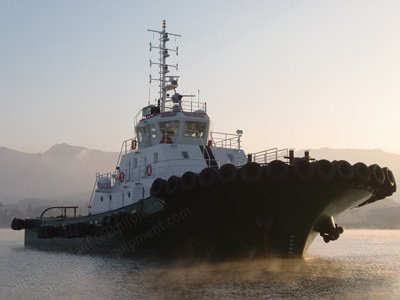
This specification together with the GA drawing no: 645-100 is intended to describe the construction of a twin screw rudder propeller tug completely outfitted and equipped for towing, pushing, and other related duties.
It will be classed to CCS as a tug for unrestricted services and will comply with the regulations of the port of registration.
General Description
The vessel is to be all welded steel construction with twin diesel engines, twin fixed pitch rudder propeller inside nozzles.
The vessel's accommodation is to be located in the main and under the main deck.
The main hull is to be divided by four (4) transverse WT bulkheads into the following compartments: forepeak SW ballast tank; crew accommodation store, FW single bottom tank; engine room, dirty oil tank, day tanks P&S, fuel oil tanks, P&S, engine control room; rudder propeller compartment; SW ballast tanks P&S.
The underdeck accommodation is to consist of: one (3) 6-man cabin; one (2) 2-man cabin.
The main deck accommodation is to consist of: one (1) captain cabin; one (1) chief engineer cabin; one (1) mess room; galley; one (1) washplace; engine casings; CO2 room; provision store.
Principal Particulars
Length overall: 36.20 m
Length w.l.: 31.25 m
Beam moulded: 10.2 m
Depth moulded: 4.4 m
Draft design / max.: 3.3 m
Tween deck heights (mean): underdeck crew's accommodation 2.40 m approx, deckhouse 2.50 m approx, wheelhouse 2.65 m approx
Accommodation
2 x 1-berth cabins: 2 men
1 x 4-berth cabins: 4 men
1 x 6-berth cabins: 6 men
Total 12 men
Tankage - Approx (100% Full)
Freshwater: 41.2 tonnes approx.
Fuel oil: 92.9 tonnes approx.
ME lub oil: 4.4 m3
Hydraulic oil: 0.5 m3
Propeller oil: 1.87 m3
Engines And Performance
Engines: 2 x 1800 MHP at 750 rpm coupled to rudder propeller
Performance speed: 12.5 knots at 100% M.C.R.
Bollard pull: 46 t with main engines at 100% MCR
Endurance: 11 days (assuming 10 hours operation per day)
Classification
The vessel is to be constructed, machinery installed and equipment and spare gear provided in accordance with the latest rules for building and classing of steel vessel to CCS (hereinafter referred to as classification) and to their special survey to hull and machinery for class MSA + AMS tug for unrestricted service (for registry vessel is to be classified for harbour limit).
Registry
The owners are responsible for the registration of the vessel. The port of registry to be advised.
Regulations
The vessel is to comply with: international loadline convention 1966; radio communication regulation to government regulations (for port limit); IMO stability guideline A167; international convention of prevention of collisions at sea 1972; international tonnage admeasurement convention 1969; MARPOL 73/78 (class to issue statement of facts of compliance to annex 1).
Certificates
The following certificates are to be supplied to the owners at the time of delivery of the vessel: builder's certificate; classification certificate (hull and machinery); safety equipment certificate (non-convention); safety construction certificate (non-convention); tonnage certificate; loadline certificate; safety radio certificate (port limit); deratisation certificate; MARPOL statement of fact (to be issued by class); bollard pull certificate (third party).
The cost of all fees and charges incurred for survey, classification and issue of certificates are to be borne by the builder.
Materials And Workmanship
All materials and workmanship are to be of good quality. All steel plates, sections, hull forging and castings are to meet classification's requirements and supplied with test certificates where required by classification. All visible steel plates are to be smooth or straight where applicable. Standard to be of J.S.Q.S.
All woods used to be suitable for the intended purpose and of good quality. All timber to be free from knots and well seasoned.
All smith work or fabricated fittings to be of neat design, strong, smooth and free from defects.
All castings to be of good quality, close grained and free from all cracks, blow holes and other defects. Steel castings to be manufactured to classification requirements and approval where required.
Welding
Vessel to be of all welded construction, in accordance with contract plans, specifications, classification. Automatic welding to be used as far as possible.
Welding to be in accordance with classification requirements. All steel used to be of good welding quality, free from laminations or other harmful defects and be class approved.
Electrodes to be selected from classification approved lists. Welding schedules to meet classification requirement/standard. High standards of up-to-date welding practice and procedures are to be applied, associated with accurate alignment, fairness, edge preparation and gap widths.
Where possible, structure should be pre-fabricated in assemblies and sub-assemblies to give the maximum possible amount of down hand welding.
Only approved welding electrodes to be used. All exposed area and all tanks except fuel oil tank to be double continuous.
Inspection And Supervision
Throughout the construction period prior to the delivery, the surveyors, owners' representative and consultants are to be given free access to the builder's yard during normal working hours for supervision and inspection. Shipyard to provide permanent cleanliness during construction period.
Tests
Prior to the delivery, the hull, all machinery, electrical, piping, all equipment installed, machinery and deck fittings, domestic equipment are to be thoroughly tested in the presence of the classification's attending surveyor, owners and/or their representative.
Inclining Experiment
Inclining experiment or lightship survey to ascertain the lightship weight and the vertical centre of gravity at lightship condition is to be carried out by the builder with the presence of classification surveyor. Basing on these results, a stability report is to be prepared by the consultants.
Dock Trials
Upon the completion of the vessel, the following trials are to be carried out: all piping systems are to be fully tested, including the checking of valve name plates; electrical power plants together with all lights; auxiliary machinery; ventilation, refrigeration machinery; all deck machinery; airconditioning machinery; all pumps, etc.
Sea Trial
Speed trials: speed trials shall be conducted over a recognised measured mile. Two (2) double runs are to be made with the engines running at maximum continuous revolutions 100% MCR, 85% MCR, 50% MCR. Records of main engine cooling water temperature and pressure, engine revolution are to be taken.
Endurance trials: endurance trials of 4 hours with the engines developing 100% MCR output is to be carried out.
Request a Quote
✓
Request sent
Thank you, our team will reply to you shortly.
Direct access to our team
Email American Plant & Equipment
Tell us what you want to buy, source, finance, or sell. A machinery specialist will follow up with you.
✓
Thank you. Your request is with the American Plant and Equipment team.
A machinery specialist will follow up with you.
Machinery updates
Subscribe to our email list
Tell us which industries you follow and we will send you the machines that match.
✓
You are on the list.
We will email you when machines that match your interests come in. Unsubscribe from any message.