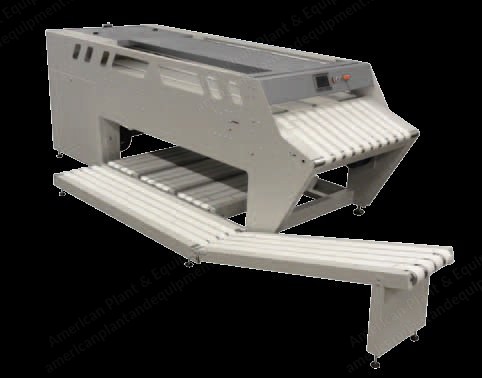
Dekken, T-Fold, Towel Folder, Max 2300x1200mm, 2 Cross Folds
Scroll to zoom
100%
Description
Overview
The t-fold towel folder is designed for folding and stacking all kinds of towels up to a length of 2300 mm.
An operator places the piece onto the infeed conveyor, where sensors automatically recognize it and then fold and sort it onto the dedicated stacker station.
No manual pre-sort is needed due to the automatic sorting system.
Once folded, towels are dispatched onto a dedicated stacker station.
After the preset stack height is achieved, the pile of folded pieces is placed onto the final incline conveyor belt.
The t-fold can make almost all folding patterns required in the textile business.
It can fold pieces up to maximum dimensions of 2300 x 1200 mm.
Infeed Conveyor
Pieces are placed on the infeed conveyor belt.
For perfect feeding quality, the conveyor belt can be selected between three running modes: automatic start, after pressing a push button (mostly used for garments), automatic start after infeed sensor is covered, or continuously running.
Piece Handling
The t-fold can be used for all kinds of towels, from small face towels to the largest and heaviest pool towels.
It has a unique design for processing very light as well as very heavy pieces.
One feature is the quality stop, allowing complicated pieces to make an additional stop for rear end correction.
Lateral Fold Principle
The longitudinal fold(s) are made by position controlled folding templates in combination with a pulsed air flow.
Once the piece enters the longitudinal fold section, the length (and possibly width) is measured and the folding templates are automatically adjusted.
Due to this measurement, the piece is recognized as well.
Once the piece is completely in the longitudinal fold section, a high accuracy pulsed air flow carries out 1 or 2 folds.
Bypassing the longitudinal fold section is possible as well.
Regardless of being a compact machine, the t-fold can handle pieces up to 230 cm.
Cross Fold Principle
After the lateral fold section, the piece enters the cross fold section.
Up to 2 cross folds can be made, offering all kinds of folding patterns required nowadays.
To secure stable and high quality folds, both cross folds are made by air assisted reversing belts.
Tight folded pieces are obtained as pieces are continuously kept between belts.
The elastic belts ensure that the cross fold automatically adapts to thin as well as thick pieces.
Pieces are supported over the full width of the 2nd cross fold, eliminating the chance of jams.
Sorting and Stacking Principle
After cross folding, the various kinds of folded pieces are sorted out onto one of the stacker stations.
The t-fold can be provided with 4 stacker stations, consequently the operator can feed 4 different pieces (mixed) which are folded and sorted out over the stacker stations.
Once the required stack height is achieved, the stack is placed onto the final incline belt.
The stack is brought onto the final incline belt by means of a slide mechanism, ensuring a smooth and straight transfer.
Options
The t-fold is an open design and can be adapted to your specifications.
Standard options include a production monitoring system.
Standard options include a master/slave system where two machines are connected and share one common incline belt, reducing space requirement and offering the possibility to direct piles straight to a packing machine without human interference.
Request a Quote
✓
Request sent
Thank you, our team will reply to you shortly.
Direct access to our team
Email American Plant & Equipment
Tell us what you want to buy, source, finance, or sell. A machinery specialist will follow up with you.
✓
Thank you. Your request is with the American Plant and Equipment team.
A machinery specialist will follow up with you.
Machinery updates
Subscribe to our email list
Tell us which industries you follow and we will send you the machines that match.
✓
You are on the list.
We will email you when machines that match your interests come in. Unsubscribe from any message.