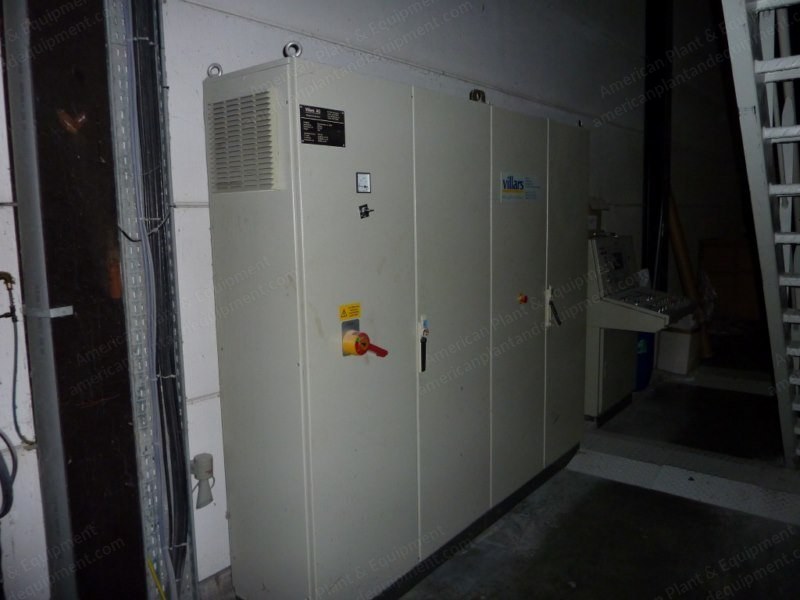
Villars-Santex, Hotmelt Powder Scattering and Laminating Machine, 1993, 2100mm, 158kW
Scroll to zoom
100%
Description
Overview
Laminating line
Manufacturer: Villars (CH) actually Santex
Year of construction: 1993
Working width: 2200 mm (nominal width 2100 mm)
Operating voltage: 3x380(400) V
Total power: 158 kW
Recommended max. speed 10 m but 15 m is possible
Original Configuration
Input unit (with possibility to hang in rollers by means of e.g. flat bearings)
Powder spreader
Infrared preheating zone
Double band laminating press (heating through IR)
Later Extension (1997)
2nd infrared zone with cold water cooled calendar
Additional Features
At the back equipped with selvedge cutting system with adjustable infrared follow up system
Strength of infrared can be adjusted so that e.g. the upper substrate can be ‘neglected’
Known Problems
Infrared preheating zone: 2 IR strips broken
Certain parts IR zones (mostly exterior zones) of the double band laminating press do not longer function, but second part of the machine can still be heated till 160 à 170°C and even more, but then at very low speed
Accumulator With Winder And Controlling System
Manufacturer: Matthijs (electrical part by Electro Vandevelde)
Year of construction: 1999
Operating voltage: 3x380 V
Capacity accumulator: +/- 50 m
Unit functions independently from laminating machine and speed varies from 0 till 50 m (speed of winding up unit = speed laminating machine when accumulator is empty)
Superstructure For Supply Second Substrate
Manufacturer: Menzel
Year of construction: 2000
Operating voltage: 3x380 V
Functions independently from the laminating machine
Speed regulation based on a 0-10 V (=0-15 m) exit signal of the laminating machine
Manual right-left guidance of the substrate
A second automatic pre-guidance is foreseen, but the motor does no longer function and it is in practice not required because the rolls are always winded straight
A measuring roller is included to measure the tension of the substrate
This measuring roller directs the motor speed so that the adjusting of the tension stays steady
It is even possible to go to a +/- tensionless situation
The line is mounted on a self-made platform equipped with a simple unwinding unit
Known Problem
Pressure roller to avoid that the substrate “slides” over the brake roller is worn out, but is in praxis not needed
Motor of the pre-guidance is broken (see above)
Miscellaneous
Self-build entry J-box with simple roll measurement
Separate J-box for unwinding from docks, so that can be laminated in the pole direction
Sewing machine Merrow to make flat seams on fine/thin fabrics
Selvedge cutters are mounted on a system so that the fabric can be levelled easily, eventually can be winded on docks
Including 2 docks of 2 m 30 of which 1 with flap bearings
Condition And
Can be inspected but not in production
Dismantled and stored at the factory in Europe
Request a Quote
✓
Request sent
Thank you, our team will reply to you shortly.
Direct access to our team
Email American Plant & Equipment
Tell us what you want to buy, source, finance, or sell. A machinery specialist will follow up with you.
✓
Thank you. Your request is with the American Plant and Equipment team.
A machinery specialist will follow up with you.
Machinery updates
Subscribe to our email list
Tell us which industries you follow and we will send you the machines that match.
✓
You are on the list.
We will email you when machines that match your interests come in. Unsubscribe from any message.