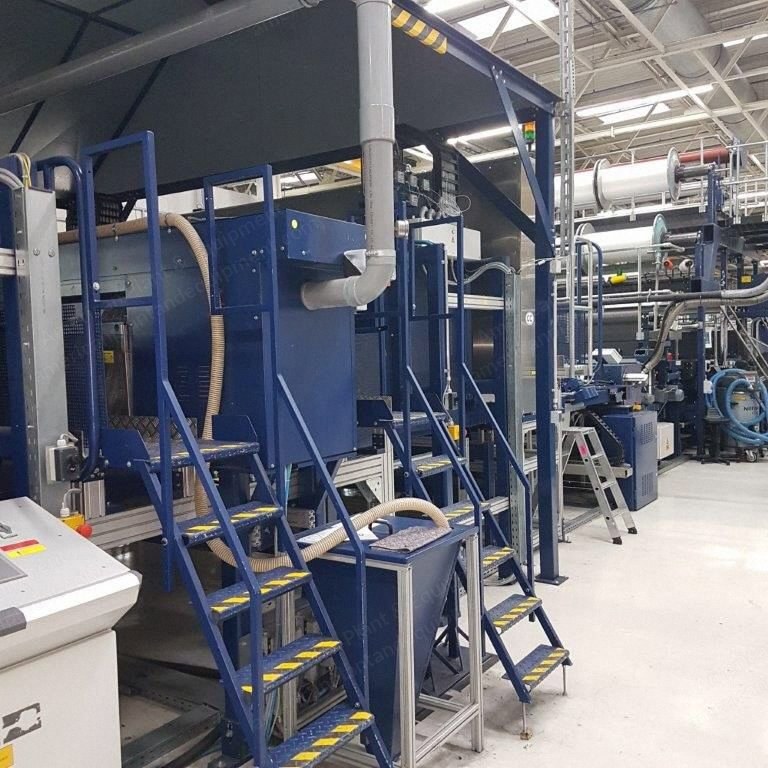
Karl Mayer, Malitronic Multiaxial and RS3 MSUS Biaxial Lines, 2010, Carbon Fiber Processing, 120" to 138" Width
Scroll to zoom
100%
Description
Overview
All lines currently running carbon fabrics
Areas of application: wind energy, aviation, automotive, boat building, ship building, construction, rail vehicles, sports industry, canalization, carparts building, creative surface finishing of all kinds, modelling, reconstructions at fracture points of sports equipment
Properties
Since all fibers point in one direction, the scrim can be ideally draped
Good soakability with little resin consumption
Can be draped very well around curves and edges
Easy to cut
Electrically conductive, infusible
High strength and rigidity due to graphite-like fiber structure
Biocompatible
Transparent to x-rays
Low specific weight
Ideal for surface use (little fiber imprints)
Ideal for processing with epoxy resin
Textile semi-finished products made of pre-spread and plane-parallel laid fibers form the group of unidirectional fabrics; the fibers are usually laid at 0°, more rarely at 90°
By laying the ud fabrics along the lines of force acting in the component, the lightweight potential of the carbon fiber is optimally exploited
Ud fabrics consist of one or more superimposed fiber layers fixed with an epoxy-compatible binder thread
The special spreading technique produces fabrics with high fiber parallelism, without knots and fiber twist
Spread fibers absorb the resin better, resulting in highest laminate strengths
Fabrics
Carbon, glass, recycled ncf/preform materials
Types of fabrics: mono, biaxial, multiaxial, nonwoven and hybrid
Directions: 0°, -45° / +45°, 90°
Weight: 50 g/m2, 300 g/m2, 450 g/m2, 600 g/m2
Width 1520 mm to 3020 mm possible
Materials: carbon fibers, glass fibers, 50 k
Karl Mayer Malitronic Multiaxial Line
Year: 2010
Gauge: e3,5 e7
Width: 138/120”
2 layersystems: -45° /90/ +45°
Space requirement: 1200 m3
Equipment: racks for tape spools and fleece rolls width 14”, 2 x 0° infeed for fleece rolls in working width, powder spreader with spreader roller and heating fields, integrated stenter frame, separate fabric take-off, sinter field, cutting device, winder, additional unwinder for reverse side powdering
Karl Mayer Rs3 Msus Biaxial Line
Gauge: e5
Width: 138”/120”
Guidebars: 2
Beamframe: 30 x 42”
Year: 2010 to 2013
Mesh correct weft insertion
Space requirement: 700 m2 per line
Equipment: c-fiber creel with 140 coins, online spreading device with 4 levels, weft insertion system for mesh-specific insertion, binding with spreader roller and heating fields, separate fabric take-off, central cutting device and edge trimming, online monitoring of fabric quality
Rs 3 Msus Stitch Point and Full Few of Line
Knitting point
Line 1
Machine type: meshed fabric
Rs3 msus biaxial powder field: powder will be placed on the fabric so that the fibers will be connected when heated
Direct way to powder
Rs 3 msus biaxial - fabric batcher
Biaxial 1 batcher
Biaxial 1 winder
Rs3 msus - biaxial: online spreading device; controls and make the carbon fibers spread to a homogen closed fabric
Online spreader 4 lines
Online spreaders 4 rows
Online spreading (2)
Online spreading
Online
Operation panel
Rs3 msus - biaxial: has online monitoring to watch the stitched fabric and reported it for high quality control
Machine type: meshed fabric
Online control of fabric
Online controling
Online monitoring
Weft System
Weftsystem of malitronic multiaxial -90 /0/+90
Weftsystem from rs3 msus biaxial machines 0 - 90 °
Shipping
Requires 16 to 19 containers to ship all 3 lines
Request a Quote
✓
Request sent
Thank you, our team will reply to you shortly.
Direct access to our team
Email American Plant & Equipment
Tell us what you want to buy, source, finance, or sell. A machinery specialist will follow up with you.
✓
Thank you. Your request is with the American Plant and Equipment team.
A machinery specialist will follow up with you.
Machinery updates
Subscribe to our email list
Tell us which industries you follow and we will send you the machines that match.
✓
You are on the list.
We will email you when machines that match your interests come in. Unsubscribe from any message.