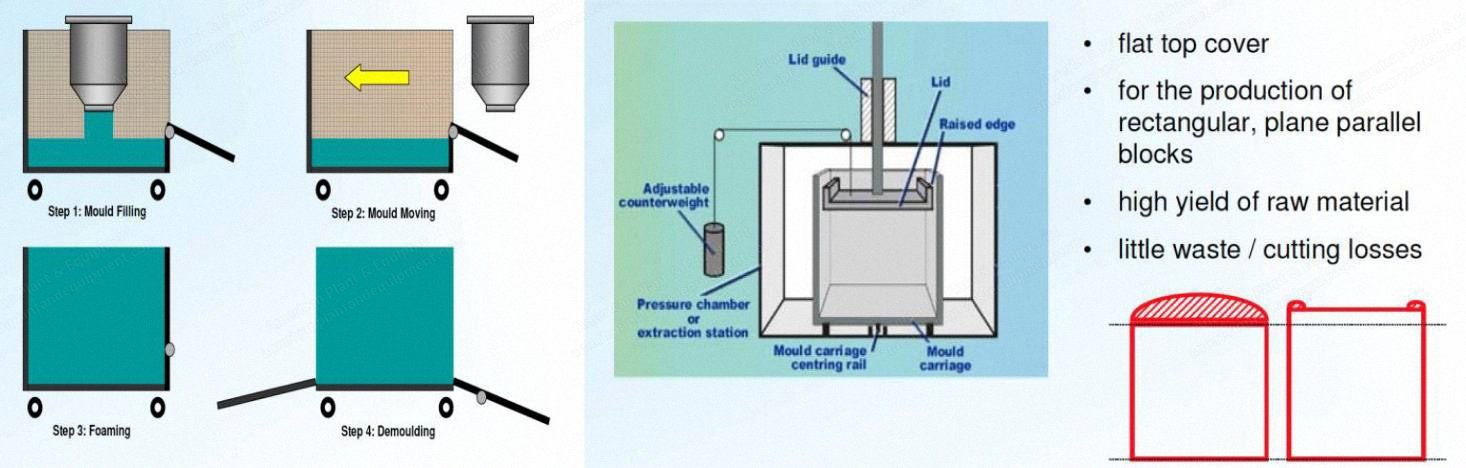
A complete line for discontinuous production of slabstock foam.
The BFM is state-of-the-art equipment for producing foam with quick start up, minimum space required and flexible production.
With this line polyurethane foams blocks can be produced, such as foams for upholstered furniture, cushions, mattresses, seats, sofas and packaging.
With this machine even high resilience HR, hyper soft HS and visco elastic foams can be produced.
Benefits With BFM Compact
A broad range of foam density 20 to 50 kg/m3
Manufacture different types of polyether based foams
Possibility to control mixer speed = high influence on cell structure
High reproducibility, thanks to formulations and modern control system
Siemens control panel
Compact design = small space requirements
Automatic flushing with polyol avoids the costs of disposal of mixture
Technical Details
Dimensions of the machine without mould: length approx 5000mm, width approx 2350mm, height approx 2550mm
Capacity: depending on quantity and size of the moulds – about 80 rectangular blocks per 8-hour-shift
Amount of moulds: 3
Machine Frame With Pump Table And Mixing Cylinder
Suitable for rectangular or cylindrical mould carriage
Maximum 1500mm wall height on rectangular mould carriage
Maximum 1500mm diameter on cylindrical moulds
One side/wall of the mould carriage has to be partially tiltable
Assembly is made easy on the machine; after fixing and leveling, it just has to be connected to the raw material tanks, pressurised air and electricity
1 mixing cylinder with frequency controlled stirrer made of stainless steel, maximum capacity 150 liters
The reaction mixture discharge into the mould carriage is realised with a hinged cover
The mixing cylinder is equipped with a special stirrer providing the optimum mixing of the components
By selecting the mixer speed and waiting times you can influence the cell size and minimize the number of pin-holes
Auto cleaning device: the mixing cylinder is equipped with an automatic cleaning device; the polyol which is going to be used for the next shot is splashed by a polyol splashing device on all surfaces of the mixing cylinder; the reactive mix is flushed and solved in polyol; however, the mixing cylinder has to be manually cleaned occasionally depending on produced quantity and formulations
The production can continue without interruption due to the auto cleaning device
1 feed tank for isocyanate made of stainless steel, capacity about 60 liters; this tank is firmly installed above the mixing cylinder; a program controlled automatic shut-off device is integrated in the bottom of the tank allowing the isocyanate to be quickly added to the mixing cylinder
Storage Tanks
1 storage tank for pure polyol capacity about 500 liters made of carbon steel, unpressurised design, with level visualisation on the PLC display including minimum level alarm
1 storage tank for HR polyol capacity about 500 liters made of carbon steel, pressurised design, with level visualisation on the PLC display including minimum level alarm
1 storage tank for isocyanate capacity about 500 liters made of carbon steel, unpressurised design with level visualisation on the PLC display including minimum level alarm
1 storage tank for amine (pure) capacity about 40 liters made of UV stabilized PE, unpressurised design
1 storage tank for water capacity about 100 liters made of UV stabilized PE, unpressurised design
2 storage tanks for silicones capacity about 100 liters made of UV stabilized PE, unpressurised design
1 storage tank for catalyst (tin) capacity about 40 liters made of UV stabilized PE, unpressurised design
All tanks are connected to the corresponding meter units by pipelines
Mould Carriage
3 mould carriage with inner dimensions of 2100 x 2100 x 1400mm
1 flat top cover for the production of rectangular, plane-parallel blocks
The mould carriages have four wheels for easy transport
The fresh block can be easily demoulded via tiltable side parts
Two sides walls can be tilted partially for filling
The flat top cover is fixed in the flat top device
Request a Quote
✓
Request sent
Thank you, our team will reply to you shortly.
Direct access to our team
Email American Plant & Equipment
Tell us what you want to buy, source, finance, or sell. A machinery specialist will follow up with you.
✓
Thank you. Your request is with the American Plant and Equipment team.
A machinery specialist will follow up with you.
Machinery updates
Subscribe to our email list
Tell us which industries you follow and we will send you the machines that match.
✓
You are on the list.
We will email you when machines that match your interests come in. Unsubscribe from any message.