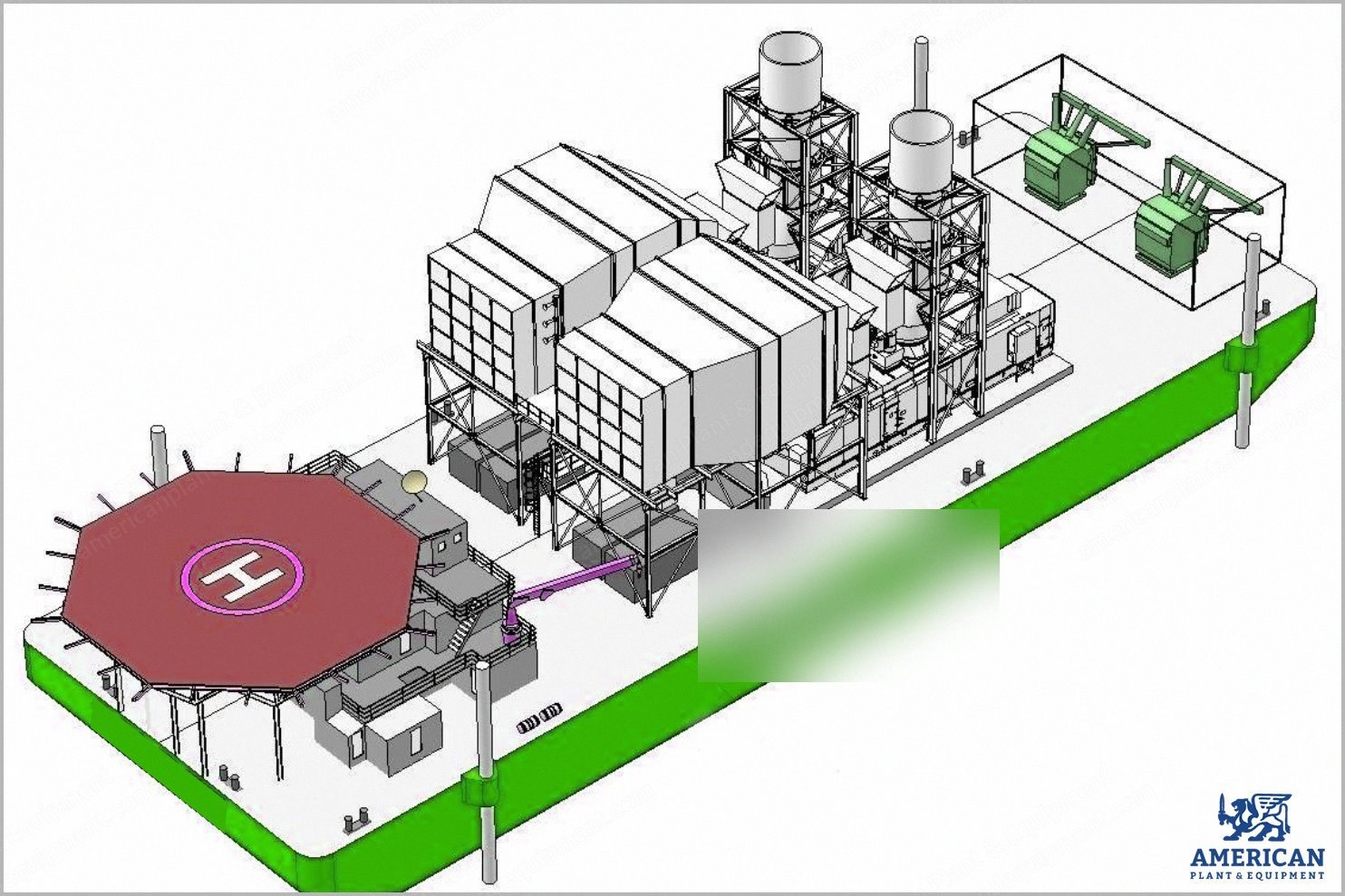
Siemens, SGT5-2000E, 173 MWe Power Barge, 20 Million Gallons Per Day Reverse Osmosis Plant, 60Hz
Scroll to zoom
100%
Description
Overview
On barge brand new unit twin installation.
300 MW, 2856 rpm, 60 Hz.
Can operate on either liquid fuel or gas.
Transportable by towing or on heavy lift vessels.
Can be moored at berth or positioned in protected waters using spuds.
Fuel supply by storage barge or piped from land-based storage.
Environmentally friendly.
Barge and systems ABS classed.
Approved by Lloyds of London.
Fuel And Water Storage
Raw turbine liquid fuel: 1,000 t.
Treated turbine fuel: 600 t.
Barge fuel storage: 100 t.
Treated water storage: 630 t.
Ballast tanks: 3,000 t.
Main Dimensions
Length overall: 82.0 m.
Breadth: 28.0 m.
Depth: 5.9 m.
Draft: 4.0 m (approx).
Complement: 10 persons.
Desalination Barge Scope
Design and build a non-self-propelled steel desalination barge with a 2 mg R.O. plant, power connection, and tanks.
Barge to accommodate 20 persons.
Reverse osmosis plant with a daily output of 20 million US gallons per day.
With 24% production increase to compensate for waste loss.
With PLC control, the system will be set up on a computer; PLC = 90,840,000.00 litres = 3,785,000.00 litres per hour (3,785 m³/h).
Rung 32 hour cycle = 75,700,000.00 litres = 20,000,000.00 US gpm based on 65% operating efficiency.
This plant produces hyper waste; production rate is 65%, leaving 35% waste.
Classification
The vessel must adhere to BV classification rules for hull, outfitting, piping, mooring, electrical, stability, and safety, as per the class notation for vessels of this size and type.
Main Dimensions (Design)
Length: 85,000 mm.
Breadth (moulded): 27,000 mm.
Depth (moulded): 5,000 mm.
Complement: 20 persons (subject to R.O. plant dimensions).
Subdivision
The hull must be compartmentalized by watertight bulkheads.
Hull
Constructed with marine quality grade A mild steel.
Longitudinal framing to be used.
Steel grade determined by classification society requirements.
Main deck (fr.0-fr.55) designed for a deck load of 10 t/m².
Transverse and longitudinal bulkheads as per class requirements.
Hull Outfitting
Hull tanks with plugs, manholes, and access arrangements.
Sea chests for onboard seawater supply.
Steel foundations for machinery and equipment.
Additional stiffening for load distribution and vibration reduction.
Bulwarks, railings/guardrails as required.
Enclosure for reverse osmosis equipment on main deck with shed structure.
Accommodation
Fitted out according to general arrangement drawing.
Cabins furnished per yard/marine practice.
Air-conditioned with central marine A/C suitable for Arabian Gulf climate.
All construction meets class/SOLAS regulations.
External steel bulkheads and decks insulated with approved materials.
Accommodation includes cold room, laundry, prayer room, recreation room, chiller freezer, etc.
Other machinery and equipment provided to fully operate the vessel.
Regulatory Compliance And Local Requirements
Local regulations: ensure that the design and construction of the barge adhere to all relevant local maritime and environmental regulations.
Permits and approvals: obtain all necessary permits and approvals from local regulatory authorities before commencing construction.
Environmental impact assessment: conduct an environmental impact assessment as required by local regulations, considering factors such as marine life and water quality.
Local content: consider local content requirements, if applicable, for sourcing materials, equipment, and services.
Material Specifications And Timeline
Project timeline: the project is to be completed as soon as possible (ASAP); clearly define milestones and deadlines for design, construction, testing, and commissioning.
Material specifications: provide detailed specifications for materials, ensuring compliance with local standards and considering factors such as corrosion resistance in the coastal environment.
Construction practices: follow local best practices for shipbuilding, welding, and other construction techniques.
Safety, Security, And Operational Aspects
Safety regulations: adhere to local maritime safety regulations, including provisions for emergency response, fire safety, and personnel protection.
Security guidelines: incorporate security measures to align with maritime security protocols.
Specifications
Capacity: 173 MWe / 20 Million US Gallons Per Day
Turbine series: SGT Series 5 2000E
Request a Quote
✓
Request sent
Thank you, our team will reply to you shortly.
Direct access to our team
Email American Plant & Equipment
Tell us what you want to buy, source, finance, or sell. A machinery specialist will follow up with you.
✓
Thank you. Your request is with the American Plant and Equipment team.
A machinery specialist will follow up with you.
Machinery updates
Subscribe to our email list
Tell us which industries you follow and we will send you the machines that match.
✓
You are on the list.
We will email you when machines that match your interests come in. Unsubscribe from any message.