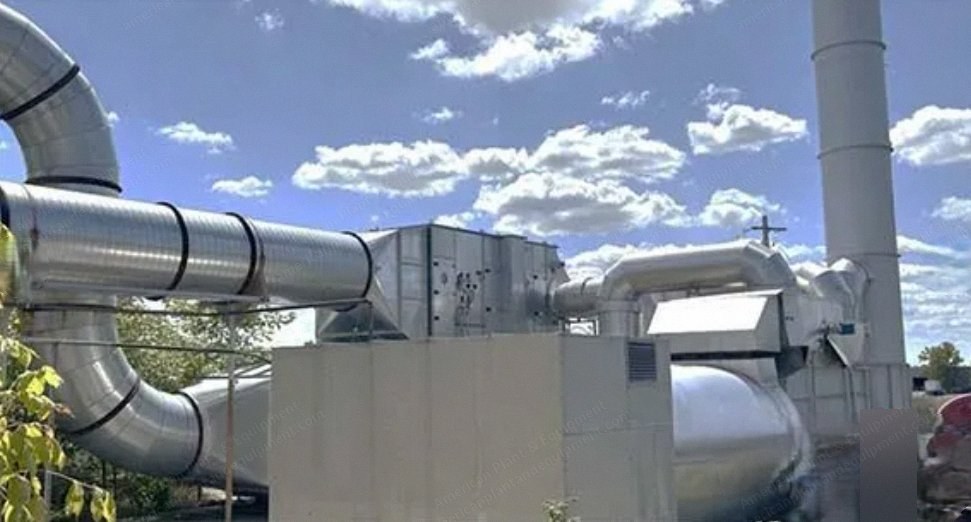
A zeolite rotor with RCO is an industrial air pollution control system that uses a zeolite rotor concentrator to capture and concentrate volatile organic compounds (VOCs) from large air volumes, which are then fed into a regenerative catalytic oxidizer (RCO) to be destroyed.
This combined system is highly effective for treating large, low-concentration air flows, as the rotor significantly reduces the air volume and increases the VOC concentration, making the oxidation process in the RCO more fuel-efficient.
Technical Details
Desorption Air Exhaust Heat Exchanger HE 1
Desorption air volume: 7,500 nm³/h
Desorption air temperature before HE: 60°C (140°F)
Desorption air temperature after HE: 500°C (932°F)
Clean air volume: 7,500 nm³/h
Clean air temperature before HE: 750°C (1,382°F)
Clean air temperature after HE: 330°C (626°F)
Exchanged amount of heat: 1,230 kW
Cooling Air – Exhaust Air Heat Exchanger HE 2
Quantity of cooling air: 7,500 nm³/h
Cooling air temperature before HE: 100°C (212°F)
Cooling air temperature after HE: 200°C (392°F)
Exhaust gas volume: 7,500 nm³/h
Exhaust gas temperature before HE: 330°C (626°F)
Exhaust gas temperature after HE: 235°C (455°F)
Exchanged amount of heat: 270 kW
Exhaust Gas – Hot Water Heat Exchanger HE 3
Exhaust gas volume: 7,500 nm³/h
Exhaust gas temperature before HE: Ø 250°C (482°F)
Exhaust gas temperature after HE: 115°C (239°F)
Secondary medium: Warm water with 30% glycol percentage
Throughput: 31 m³/h
Temperature before HE (secondary medium): 90°C (194°F)
Temperature after HE (secondary medium): 110°C (230°F)
Exchanged amount of heat: Ø 370 kW (max. 650 kW)
Exhaust Air – Fresh Air Heat Exchanger HE 4
Exhaust air volume: 75,000 nm³/h
Exhaust air temperature before HE: 25°C (77°F)
Exhaust air temperature after HE: -3°C (26°F)
Amount of fresh air: 75,000 nm³/h
Fresh air temperature before HE: -15°C (5°F)
Fresh air temperature after HE: +15°C (59°F)
Exchanged amount of heat: 750 kW
Exhaust Gas and Clean Air Values
Organic C – concentration after concentrator: max. 50 mg/nm³
Organic C – concentration after RTO burner: max. 20 mg/nm³
CO – concentration after RTO burner: max. 100 mg/nm³
NOx – concentration after RTO burner: max. 100 mg/nm³
Measured values as ½ hour average values based on actual measured oxygen content.
Resources
Electric power: 3x480V, 60Hz + PE + N
Rated power supply: 155 kW
Natural gas: Hu = 38,600 kj/nm³
Natural gas - pre pressure: Pe = 100 mbar flow pressure /// Pe = 1.45 psi flow pressure
Natural gas - connected load: 85.0 nm³/h
Compressed air: Oil-free /// dry
Compressed air - pre pressure: min. 6.0 bar(g) /// min. 87 psi(g)
Compressed air - connected load: 1.0 nm³/h
Resource Consumption
Natural Gas
At 75,000 nm³/h exhaust air without pollutant content: 75 nm³/h
At 75,000 nm³/h exhaust air with 800 mg/nm³ solvent: 15 nm³/h
Compressed Air
Compressed air consumption for cooling UV probe: 1.0 nm³/h
Compressed air consumption for emergency cooling concentrator: 100.0 nm³/h
Electric Power
Without heat recovery (HE4): 120.0 kWh
With heat recovery (HE4): 150.0 kWh
Request a Quote
✓
Request sent
Thank you, our team will reply to you shortly.
Direct access to our team
Email American Plant & Equipment
Tell us what you want to buy, source, finance, or sell. A machinery specialist will follow up with you.
✓
Thank you. Your request is with the American Plant and Equipment team.
A machinery specialist will follow up with you.
Machinery updates
Subscribe to our email list
Tell us which industries you follow and we will send you the machines that match.
✓
You are on the list.
We will email you when machines that match your interests come in. Unsubscribe from any message.