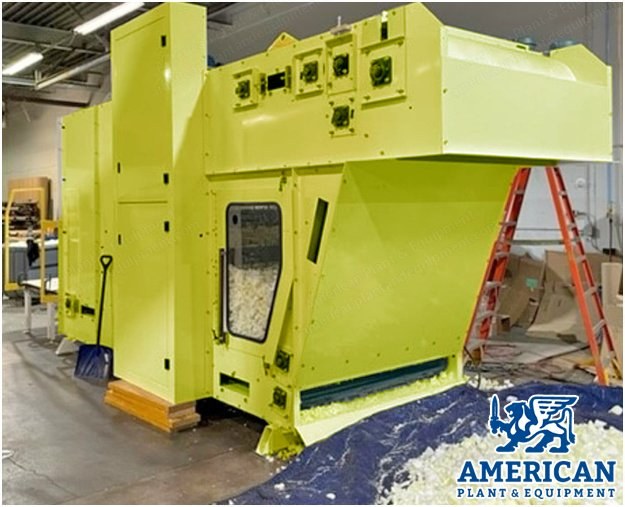
Machine footprint = 286.5 inches (7,277.1 mm) long x 83.86 inches (2,130.0 mm) wide x 124.4 inches (3,159.8 mm) tall
Year installed: October, 2023
Production started January, 2024, but never used as part of production line
Condition
Lightly used
Installed as risk mitigation for material supply chain risks
Never used in production environment but occasionally turned on and run to clean (less than 6 hours weekly)
Production Criteria
Output minimum: 2,000 lbs (907 kg) of foam per hour
Output maximum: 3,000+ lbs of foam per hour
Reclamation: capable of reclaiming dust byproduct and spilled pieces of raw materials (foam) at all points along the physical length of the production line
Raw material processing: equipment is capable of processing various types of foam raw materials into individual pieces based on size, density, hardness that have been tested in Rando lab facility
Ergonomics, Safety and Maintenance
Equipment is designed to be in accordance with or exceed requirements as established by OSHA
Provision of manuals for trouble-shooting
Access to program software/controllers in order to make refinements to sensors and other program parameters
Spare parts provided
Utility Criteria
Electrical: wired for 3 phase, 480 V, US power
Rando Web Processing Line Overview
The Rando Web Process® is a highly versatile air laid web forming system. A wide range of fiber types, such as glass, carbon, metallic, synthetic, wood, waste, etc. can be processed into air laid webs with extremely high efficiency.
The Rando process provides the flexibility of obtaining a broad range of web weights or densities from a magnitude of deniers with 360-degree fiber orientation for improved web strength.
Equipment Application and Use
The RANDO™ 2+2 Bale Breaker is designed to accept high density bales of fiber. The bales are placed on the load apron and slowly advance into the rotating beater rolls. The beater rolls tear the bale into small clumps of fiber which are thrown into the hopper section of the bale breaker. If using a blend line volumetric reserve instead of fiber bales, loose fiber will be fed into the rear section of the machine. The action of the elevating and stripper aprons reduces the high-density clumps into small high-density pieces called “tufts”. The tufts are then metered at a uniform rate by the doffer roll into the discharge transition. A photo eye monitors the fiber level in the hopper area, turning the load apron on and off based on demand.
The output poundage of the RANDO™ machinery will vary depending on the fiber being used. Please consult with Rando Machine for specifics.
The Rando RBB and RBLVR is designed for use in a fiber blending operation. Typically, each fiber used in a blend would have its own designated machine. The fibers would be deposited on a blend line conveyor which in turn would feed a volumetric reserve.
The anti-static assembly (if provided) is electrically interconnected with the feed control. The air pressure required for controlling the amount of spray should be between 10 to 20 PSI. However, experience with the various fibers will enable the proper setting to be determined for the specific application. Excessive wetting of the fiber and interior of the machine walls and associated machine parts should be avoided.
Specifications
Weight: 4762.72
Request a Quote
✓
Request sent
Thank you, our team will reply to you shortly.
Direct access to our team
Email American Plant & Equipment
Tell us what you want to buy, source, finance, or sell. A machinery specialist will follow up with you.
✓
Thank you. Your request is with the American Plant and Equipment team.
A machinery specialist will follow up with you.
Machinery updates
Subscribe to our email list
Tell us which industries you follow and we will send you the machines that match.
✓
You are on the list.
We will email you when machines that match your interests come in. Unsubscribe from any message.