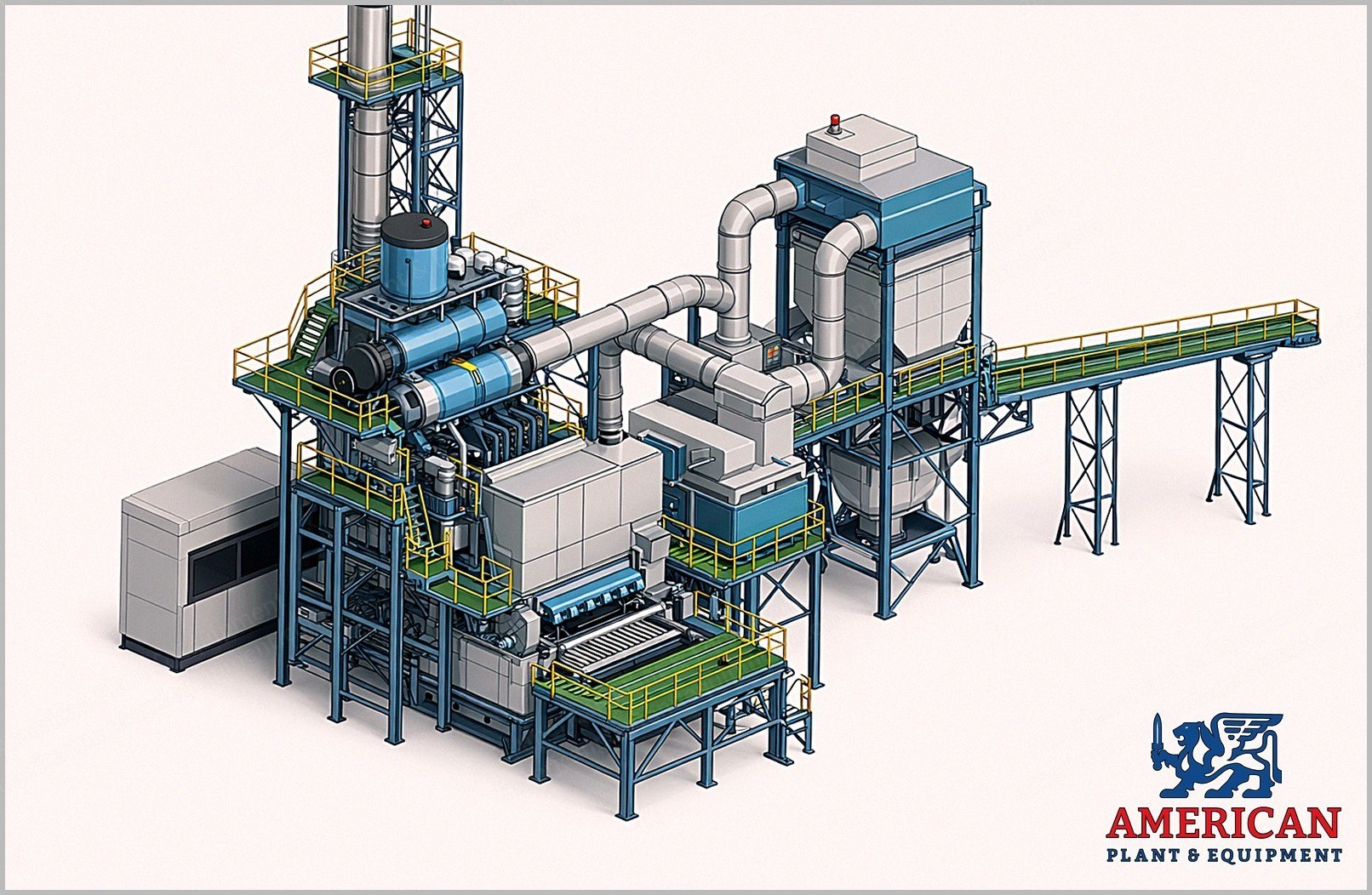
Description
Overview
Brand: NovaStar
Model: BT139
Condition: New
Quantity: 1 unit
Steam boiler fired on solid fuel, running unattended under automatic control, rated from 1 TPH up to 50 TPH.
New machine, drawn from a line currently in production.
Pressure parts and heat exchangers on this line are fabricated to ASME rules.
Furnace and Grate
Fully water tube design: the furnace is built up from membrane water wall panels and carries no refractory lining.
Furnace tubing is left free to expand as it heats.
The grate is cooled by circulating boiler feed water, which holds the bed temperature down, keeps the ash below its fusion point and trims NOx formation.
Fuel is advanced along the grate mechanically, so the bed is never raked by hand and the grate needs no operator once it is running.
Two settings tune the burn to the fuel: the inclination of the grate, and the stroke rate at which the bed is advanced.
Steam Output and Performance
Rated steam output runs from 1 TPH up to 50 TPH, roughly 2,200 to 110,000 lb/hr from and at 212 degF (100°C).
Safety valves are set to order at about 10.5, 17.5, 21, 45 and 63 bar(g), that is roughly 152, 254, 305, 653 and 914 psig, and higher settings are available on request.
Steam leaves dry saturated, or superheated where the duty asks for it.
Peak thermal efficiency reaches 87%, referred to the net (lower) heating value of the fuel.
Steam generation, combustion and draft are each held by step-less modulating control.
Turndown is 4:1, so the boiler stays steady down to a quarter of full load.
Auxiliary power draw is 6 to 7 kW (8.0 to 9.4 hp) for each TPH of steam raised, about 2.7 to 3.2 kW per 1,000 lb/hr.
Fuels
Fuels accepted: wood chips, pellets and briquetted biomass; bagasse; husk and shell residues, rice husk, coconut shell and cashew shell among them; and coal of widely varying grade.
Takes fuel sized between 10 mm (0.4 in) and 25 mm (1.0 in), about 3/8 to 1 in, and is not demanding about particle size.
Fuel feed and ash extraction are both mechanized.
Construction and Maintenance
Shop fabricated, in assemblies sized to be transported.
The grate assembly lies outside the pressure part boundary, so it can be worked on without disturbing certified pressure components.
Ash leaves the boiler on its own, at somewhere under about 50 degC (120 degF).
A screw conveyor carries that ash away with no operator involved.
Better than 90% of the ash is collected at the discharge end of the grate.
Soot blowers are steam driven and work with the boiler online.
Emissions and Environment
With a bag filter fitted, suspended particulate matter comes down to roughly 50 mg/Nm3, on the order of 0.02 gr/dscf.
Swap in a multi-cyclone and particulate runs between 150 and 250 mg/Nm3, roughly 0.07 to 0.11 gr/dscf, with the boiler fully loaded.
Combustion Air, Control and Instrumentation
Control system is PLC based.
Combustion air is delivered in four separate zones, each regulated on its own.
Below the bars, primary air is admitted compartment by compartment and trimmed automatically.
Drum level is held by a modulating controller.
Oxygen in the flue gas is read continuously.
Fuel is weighed batchwise on load cells.
Draft is balanced under closed-loop control.
The ash discharge sequence runs entirely on its own.
Heat Recovery and Special Features
Heat picked up by the grate cooling circuit is returned to the deaerator.
The economizer carries protection against cold-end corrosion.
Feed water is warmed in a steam driven pre-heater.
Flow into that pre-heater is under modulating control.
Nothing special is needed to bring the boiler up from cold.
Thermal efficiency is established against a recognized boiler efficiency test code.
Scope of a Typical Plant
Bag filter.
Deaerator tank, pressurized.
Steam drum.
Economizer.
Spark trap.
Conveyor for fuel handling.
Fuel hopper.
Stack carried on an external support structure.
Water walled furnace fitted with its water cooled grate.
Control room.