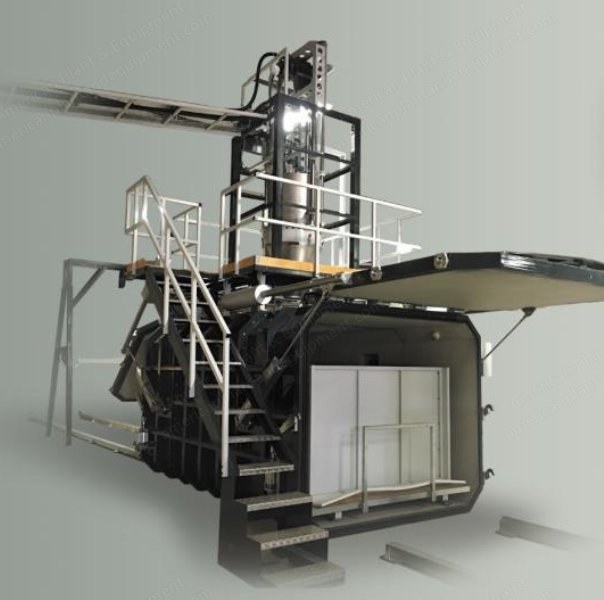
Polyurethane Foam Block Machinery, Pressure Controlled Chamber, Discontinuous System
Scroll to zoom
100%
Description
Overview
Produces conventional foams, viscoelastic (memory) foams, HR foams, 2-component system foams, other special foams, and rigid foams.
For manufacturers of PU foam for mattresses, furniture, clothing, packaging, insulation, and others.
Production Process
Introduce formula (or recall previously recorded formula), start cycle.
Automatic weight of each component, pumping of polyol and catalysts/additives to the reactor for mixing (premix).
Transfer of the premix to its compartment in the transfer and blending at 3000 rpm in the high-speed mixing head.
Automatic weight and pumping of the isocyanate to its compartment in the transfer.
Descent of the transfer to the bottom of the mold, inside the hyperbaric chamber. Mixing of polyol premix and isocyanate in the mixing cone. Opening of the pouring valve with radial pouring of the final mix at the bottom of the mold.
Ascent of the transfer and closing of the hyperbaric chamber. Foam growth under controlled pressure.
The emissions are all extracted because they are contained in a closed stack that goes out through the roof.
Advantages
Discontinuous system: versatile – change formulas and molds between batches to produce the exact quantity needed of different foams.
Discontinuous system: productive – very high output, low cycle times (6 to 10 minutes), production “just in time”, small footprint.
Discontinuous system: efficient – no foam waste when changing formulas, produces rectangular blocks and cylindrical blocks for peeling without waste; excellent reproducibility with the dosing system and software; environmentally friendly, no cleaning water.
Pressure controlled chamber: works with positive and negative pressure.
Pressure controlled chamber: positive pressure increases hardness in foams produced with standard polyols.