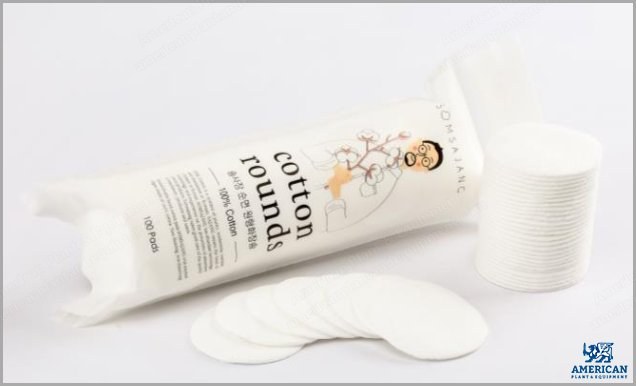
Hydro-entangled cotton nonwoven in 240 mm wide at a weight of 190 to 250 gsm.
Made of 100% absorbent cotton, 100% rayon, or any desired combination of cotton and rayon.
Embossing Roller (Option)
This additional unit enables you to emboss cotton webs with any desired design.
Embossing improves the stability of the product and makes it look more attractive.
Die-Cut for Different Shapes
Round: 50 mm diameter (4 cavity).
Oval: 70 x 90 mm (3 cavity).
Square: 75 mm x 75 mm (3 cavity).
Rectangular: 110 mm x 90 mm (2 cavity).
Marking Device for Counting
The model is equipped with a specially designed counting system which, upon reaching the pre-selected number of pieces, inserts the paper onto the last cotton pad.
The marking paper is only visible under black light.
The marking paper shall be separated by manual so cotton pads will not contain any fluorescent materials.
Electric Control
Human machine interface system (HMI).
It allows the operator to find an error easily through touch screen.
Power Consumption and Compressed Air
Power consumption: 17.5 kW/hour.
Compressed air: 6 bar.
Production Capacity
Production speed: 240 strokes/minute at maximum.
Cutting: 4 cuts/stroke for 57 mm diameter of pads.
Output: Up to 960 round cotton pads per minute.
Packing
The product is stacked in channels and is simultaneously counted electronically.
The desired number per package can be preset by an electronic counter.
From the channels, the product is filled by an operator into the package, i.e. into polyethylene bags.
Request a Quote
✓
Request sent
Thank you, our team will reply to you shortly.
Direct access to our team
Email American Plant & Equipment
Tell us what you want to buy, source, finance, or sell. A machinery specialist will follow up with you.
✓
Thank you. Your request is with the American Plant and Equipment team.
A machinery specialist will follow up with you.
Machinery updates
Subscribe to our email list
Tell us which industries you follow and we will send you the machines that match.
✓
You are on the list.
We will email you when machines that match your interests come in. Unsubscribe from any message.