NGR, X:Gran 145 HD, 900 to 1000 kg/h, 145mm Extruder, Regranulation Line
Scroll to zoom
100%
Description
Overview
Overconsumption: 500 kW
Output: 1000 kg per hour
Intended for the following waste: BOPP film, fluff, lumps, MDO waste: 900 to 1000 kg/h; CPP film, fluff, lumps: 900 to 1000 kg/h
Performance is provided for reference only
The capacity of the device depends on the properties of the material, e.g. moisture content, printing, weight, melt index, contamination and degree of filtration
Average power consumption: 500 kW
Average cooling water demand: 668 l/min
Average fresh water consumption: 34 l/h
Maximum compressed air consumption: 100 l/min
The values given above are only reference values and may differ from the final values obtained after calibration of the device; this data should not be used for planning
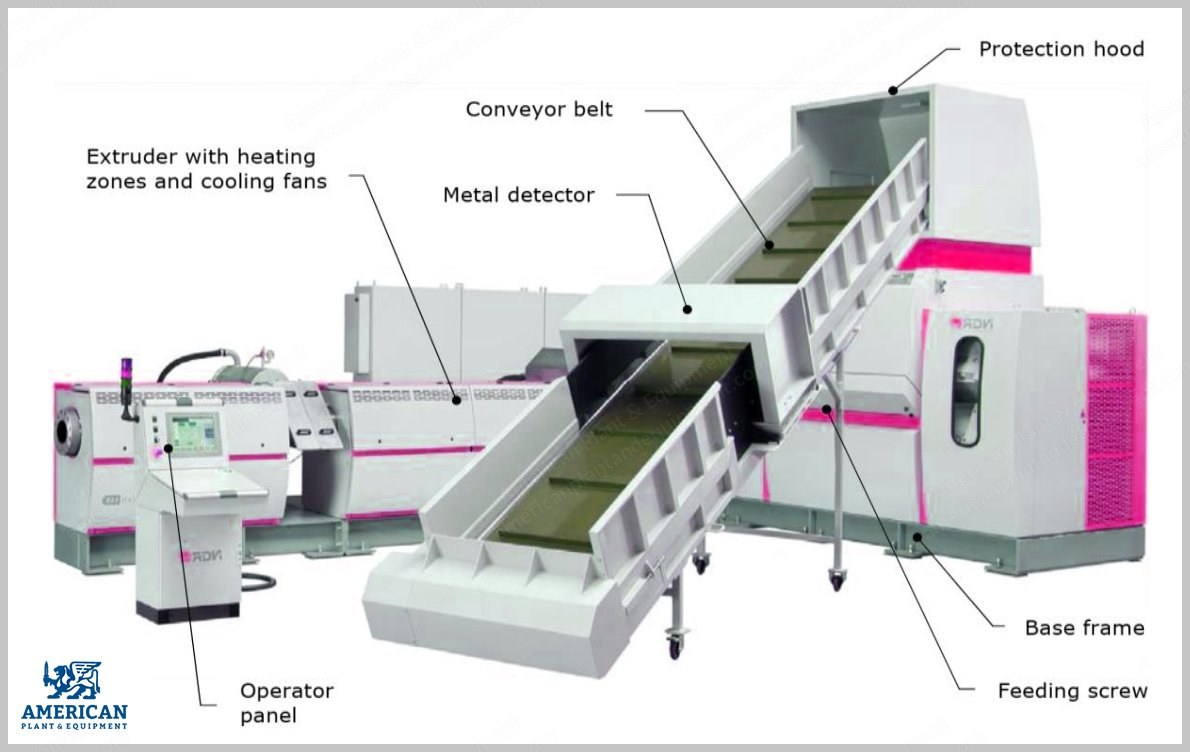
Cutter-Feeder Extruder Combination
The hydraulically operated slider pushes the waste material towards the rotating cutter shaft; this slider is controlled by the amperage of the shaft to reach a constant output of the extruder
The material is cut between rotating and stationary blades; the cut material is axially transported, friction heated and compressed and then fed into the extruder, where melting and mixing take place
The bimetallic (more wear resistant) extruder has a heating-cooling combination which is equipped with melt pressure and melt temperature sensors
The extruder screw is nitrogen hardened and has amounted flanks for additional wear resistance
The whole plant including the screen changer, pelletizing unit and downstream equipment is PLC controlled
Single Shaft Shredder
Hopper capacity: 1.6 m³
Width of cutter shaft: 1400 mm
Shaft drive: 90 kW
Hydraulic aggregate: 7.5 kW
Feeding Screw
Feeding screw diameter: 200 mm
Feeding drive: 45 kW frequency controlled
Extruder
Extruder screw diameter: 145 mm
L/D ratio: 30
Heating capacity: 60 kW
Extruder Drive Unit 250 kW
Extruder drive: 250 kW
Conveyor Belt Incl. Metal Detector
The conveyor belt transports the waste material via an all-metal detector with an opening of 560 x 900 mm into the hopper of the cutter-feeder extruder combination
The metal detector is equipped with an optical and acoustical alarm and stops the material feed immediately upon detection of metal parts
Length of belt: 7000 mm
Width of belt: 900 mm
Drive: 1.5 kW
Belt speed: 0.2 m/s
Accuracy detection: > M6 nut
Reel Feeder (Maximum Intake Capacity 750 kg/h)
Suitable device for the feeding of reel stock to the cutter-feeder extruder combination
Two rollers with infinitely variable speed clamp the film and transport it with adjustable force into the hopper
Suitable for continuous feeding of TDO film with maximum width of 6600 mm
Maximum feeding width: 600 mm
Feeder drive: 2.2 kW
Maximum feeding rate: 60 m/min
Maximum feeding force: 4110 N
Screen Changer
Used for continuous melt filtration
Two hydraulically driven pistons contain the filters, which can be changed without stopping the process (one stays in operation, the other can be changed)
Process is adjusted accordingly via melt pressure before screen changer
Screen size in operation: 2 x 345 cm² (x 38 inches²)
Screen size: 176.3 mm (6.94 inches)
Screens: 2
Heating capacity: 19.2 kW
Hydraulic drive: 5.5 kW
Pelletizing Unit Incl. Downstream Equipment
The water-ring die-face pelletizer with feeding unit and the centrifuge are made of stainless steel, equipped with water filtration and water recycling tank
Wear resistant die with adjustable knife pressure and infinitely variable pelletizing speed
Pelletizer drive: 2.2 kW
No. of blades: 4
Centrifuge drive: 5.5 kW
Water pump: 7.5 kW
Heating capacity: 5 kW
Automatic Adjustment of Speed of Pelletizing Unit
Automatic adjustment of pelletizing speed controlled via a melt pressure sensor measured between screen changer and die
Screw: land cladded and nitrided, hardness 54-56 HRC
The lifetime of the screw cannot be guaranteed because this is dramatically influenced by the processed materials, the contamination and additives
Colour
The system is executed in following colours: grey RAL 7035 / RAL 7046 and yellow RAL 1021
Safety Regulations
The installation has been designed and manufactured in accordance with DIN, CE and ISO safety guidelines
It is the customer's responsibility to comply with any local safety requirements
Documentation
1 x in paper form, 1 x on CD-ROM
Along with the installation, it provides a full set of documentation for the installation in English, which includes: list of spare and wearing parts, operation and maintenance manual, installation instructions
Electricity
Standards (NGR): TN-C network with a directly earthed point in which an earth conductor (PE) is connected to this point
Three phase system 0-conductor
Voltage: 3 x 400 volt, probable fluctuation maximum: ± 5%
The cooling water has to be chemically neutral and is not allowed to be aggressive
Cooling water is closed or open loop circuits and water quench system must have the following properties: temperature maximum 15 °C, cooling water inlet tolerance +/- 2 °C maximum, general requirements no sediment, pH index (at 25 °C) 7.5-9, electrical conductivity < 150 µS/cm, total hardness < 5 °dH, carbonate hardness < 3 °dH, chlorides < 40 mg/l
Second Cooling System
Depending on the quality of the water, it can cause calcification when the temperature rises above 55 °C
In this case, a second water system is necessary, in which process water flows
There must be no deposits or calcification in the cooling water inlet
Alternative Systems in Case of Too High Carbonate Hardness of Water
If the carbonate hardness of the water is too high, the customer must install special water softening equipment or a cooling system with a heat exchanger
If a cooling unit is used, it is essential to follow the installation and operation instructions provided by the unit manufacturer
Water Requirements
Cooling water requirements are dependent on the quality and form of the material produced and the allowable temperature difference between the cooling water inlet and outlet
If the water quality deviates, the customer must install special water softening equipment or a cooling system with a heat exchanger
Request a Quote
✓
Request sent
Thank you, our team will reply to you shortly.
Direct access to our team
Email American Plant & Equipment
Tell us what you want to buy, source, finance, or sell. A machinery specialist will follow up with you.
✓
Thank you. Your request is with the American Plant and Equipment team.
A machinery specialist will follow up with you.
Machinery updates
Subscribe to our email list
Tell us which industries you follow and we will send you the machines that match.
✓
You are on the list.
We will email you when machines that match your interests come in. Unsubscribe from any message.