
Search results for: 'Still'
-
 TT-6393 BOTTLING LINE FOR SPARKLING BEVERAGES UP TO 9000 BPH, YEAR 2005 TO 2016TT-6393 BOTTLING LINE FOR SPARKLING BEVERAGES UP TO 9000 BPH, YEAR 2005 TO 2016 1. BOTTLING LINE FOR SPARKLING BEVERAGES UP TO 9000 BPH 2. IN PRODUCTION 3. SPEED: 9000 BOTTLES PER HOUR 4. CONTAINERS: PET 5. PRODUCT: SOFT DRINKS, WATER (SPARKLING), WATER (STILL) 6. FILL TYPE: ISOBARIC 7. NECK TYPE: 28mm 8. MACHINE HOURS: 52428 QUANTITY: 1 Learn More
 -
 J-1563 COFFEE, SYRUP, LABELERS, CARTONERS AND SIMILAR EQUIPMENT
COFFEE, SYRUP, LABELERS, CARTONERS AND SIMILAR EQUIPMENT
Learn More -
 TT-6958 SAVIO DOUBLE TWIST AND DOUBLE MACHINING MACHINE WITH 240 SPINDLES EACH, YEAR 1995TT-6958 SAVIO DOUBLE TWIST AND DOUBLE MACHINING MACHINE WITH 240 SPINDLES EACH, YEAR 1995 ITEM 001 1. SAVIO 15 N DOUBLE TWIST 2. 240 SPINDLES EACH 3. FEEDING FROM TWIN BOBBIN 8" (200mm) QUANTITY: 2 ITEM 002 1. RITE DOUBLE MACHINING MACHINE 2. MODEL AGR 3. 16 HEADS QUANTITY: 1 ITEM 003 1. RITE DOUBLE MACHINING MACHINE 2. MODEL AGR WITH 24 HEADS 3. SINGLE-SIDED QUANTITY: 1 ITEM 004 1. FADIS TUAN/B-S 30-HEAD DOUBLE MACHINING MACHINE 2. OF 30 HEADS 2 HEADS 3. ONE MOTOR FOR EACH HEAD QUANTITY: 1 Learn More
 -
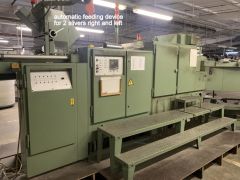 TT-4240 NSC GILLBOX GC12 AND 13, YEAR 1986 TO 1990TT-4240 NSC GILLBOX GC12 AND 13, YEAR 1986 TO 1990 ITEM 001 NSC GILLBOX GC12, YEAR 1986 GOOD CONDITION, STILL RUNNING QUANTITY: 1 ITEM 002 NSC GILLBOX GC13, AUTOLEVELLER, YEAR 1990 GOOD CONDITION, STILL RUNNING QUANTITY: 1 ITEM 003 NSC GILLBOX GC13, YEAR 1988 GOOD CONDITION, STILL RUNNING. QUANTITY: 1 Learn More
 -
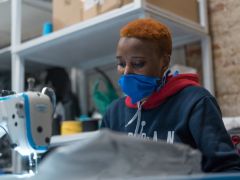 D-2388 What’s the Best Material for a Mask?
Federal health officials have now recommended that we cover our faces with fabric during the coronavirus pandemic. But what material offers the most protection?
The Centers for Disease Control and Prevention has posted a no-sew mask pattern using a bandanna and a coffee filter as well as a video on making masks using rubber bands and folded fabrics found at home.
While a simple face covering can reduce the spread of coronavirus by blocking outgoing germs from coughs or sneezes of an infected person, experts say there is more variation in how much homemade masks might protect the wearer from incoming germs, depending on the fit and quality of the material used.
Scientists around the country have taken it upon themselves to identify everyday materials that do a better job of filtering microscopic particles. In recent tests, HEPA furnace filters scored well, as did vacuum cleaner bags, layers of 600-count pillowcases and fabric similar to flannel pajamas. Stacked coffee filters had medium scores. Scarves and bandanna material had the lowest scores, but still captured a small percentage of particles.
If you don’t have any of the materials that were tested, a simple light test can help you decide whether a fabric is a good candidate for a mask.
“Hold it up to a bright light,” said Dr. Scott Segal, chairman of anesthesiology at Wake Forest Baptist Health who recently studied homemade masks. “If light passes really easily through the fibers and you can almost see the fibers, it’s not a good fabric. If it’s a denser weave of thicker material and light doesn’t pass through it as much, that’s the material you want to use.”
Researchers say it’s important to remember that lab studies are conducted under perfect conditions with no leaks or gaps in the mask, but the test methods give us a way to compare materials. And while the degree of filtration for some homemade masks seems low, most of us — who are staying home and practicing social distancing in public — don’t need the high level of protection required for medical workers. More important, any face covering is better than none, especially if worn by a person who has the virus but doesn’t know it.
The biggest challenge of choosing a homemade mask material is to find a fabric that is dense enough to capture viral particles, but breathable enough that we can actually wear it. Some items being touted online promise high filtration scores, but the material would be unwearable.
Dressing Up for Work … at Home
Yang Wang, an assistant professor of environmental engineering at Missouri University of Science and Technology, worked with his graduate students to study various combinations of layered materials — including both air filters and fabric. “You need something that is efficient for removing particles, but you also need to breathe,” said Dr. Wang, who last fall won an international award for aerosol research.To test everyday materials, scientists are using methods similar to those used to test medical masks, which everybody agrees should be saved for medical workers who are exposed to high doses of virus from seeing infected patients. The best medical mask — called the N95 respirator — filters out at least 95 percent of particles as small as 0.3 microns. By comparison, a typical surgical mask — made using a rectangular piece of pleated fabric with elastic ear loops — has a filtration efficiency ranging from 60 to 80 percent.
Dr. Wang’s group tested two types of air filters. An allergy-reduction HVAC filter worked the best, capturing 89 percent of particles with one layer and 94 percent with two layers. A furnace filter captured 75 percent with two layers, but required six layers to achieve 95 percent. To find a filter similar to those tested, look for a minimum efficiency reporting value (MERV) rating of 12 or higher or a microparticle performance rating of 1900 or higher.
The problem with air filters is that they potentially could shed small fibers that would be risky to inhale. So if you want to use a filter, you need to sandwich the filter between two layers of cotton fabric. Dr. Wang said one of his grad students made his own mask by following the instructions in the C.D.C. video, but adding several layers of filter material inside a bandanna.
Dr. Wang’s group also found that when certain common fabrics were used, two layers offered far less protection than four layers. A 600 thread count pillow case captured just 22 percent of particles when doubled, but four layers captured nearly 60 percent. A thick woolen yarn scarf filtered 21 percent of particles in two layers, and 48.8 percent in four layers. A 100 percent cotton bandanna did the worst, capturing only 18.2 percent when doubled, and just 19.5 percent in four layers.
The group also tested Brew Rite and Natural Brew basket-style coffee filters, which, when stacked in three layers, showed 40 to 50 percent filtration efficiency — but they were less breathable than other options.
If you are lucky enough to know a quilter, ask them to make you a mask. Tests performed at the Wake Forest Institute for Regenerative Medicine in Winston-Salem, N.C., showed good results for homemade masks using quilting fabric. Dr. Segal, of Wake Forest Baptist Health, who led the study, noted that quilters tend to use high-quality, high-thread count cotton. The best homemade masks in his study were as good as surgical masks or slightly better, testing in the range of 70 to 79 percent filtration. Homemade masks that used flimsier fabric tested as low as 1 percent filtration, Dr. Segal said.
The best-performing designs were a mask constructed of two layers of high-quality, heavyweight “quilter’s cotton,” a two-layer mask made with thick batik fabric, and a double-layer mask with an inner layer of flannel and outer layer of cotton.
Bonnie Browning, executive show director for the American Quilter’s Society, said that quilters prefer tightly woven cottons and batik fabrics that stand up over time. Ms. Browning said most sewing machines can handle only two layers of fabric when making a pleated mask, but someone who wanted four layers of protection could wear two masks at a time.
Ms. Browning said she recently reached out to quilters on Facebook and heard from 71 people who have made a combined total of nearly 15,000 masks. “We quilters are very much in the thick of what’s going on with this,” said Ms. Browning, who lives in Paducah, Ky. “One thing most of us have is a stash of fabric.”
People who don’t sew could try a folded origami mask, created by Jiangmei Wu, assistant professor of interior design at Indiana University. Ms. Wu, who is known for her breathtaking folded artwork, said she began designing a folded mask out of a medical and building material called Tyvek, as well as vacuum bags, after her brother in Hong Kong, where mask wearing is common, suggested it. (DuPont, the maker of Tyvek, said in a statement that Tyvek is intended for medical apparel, not masks.) The folded mask pattern is free online, as is a video demonstrating the folding process. In tests at Missouri University and University of Virginia, scientists found that vacuum bags removed between 60 percent and 87 percent of particles. But some brands of vacuum bags may contain fiberglass or are harder to breathe through than other materials, and shouldn’t be used. Ms. Wu used a bag by EnviroCare Technologies, which has said it does not use fiberglass in its paper and synthetic cloth bags.
“I wanted to create an alternative for people who don’t sew,” said Ms. Wu, who said she is talking to various groups to find other materials that will be effective in a folded mask. “Given the shortage of all kinds of materials, even vacuum bags might run out.”
The scientists who conducted the tests used a standard of 0.3 microns because that is the measure used by the National Institute for Occupational Safety and Health for medical masks.
Linsey Marr, a Virginia Tech aerosol scientist and an expert in the transmission of viruses, said the certification method for respirators and HEPA filters focuses on 0.3 microns because particles around that size are the hardest to catch. While it seems counterintuitive, particles smaller than 0.1 microns are actually easier to catch because they have a lot of random motion that makes them bump into the filter fibers, she said.
“Even though coronavirus is around 0.1 microns, it floats around in a wide range of sizes, from around 0.2 to several hundred microns, because people shed the virus in respiratory fluid droplets that also contain lots of salts and proteins and other things,” said Dr. Marr. “Even if the water in the droplets fully evaporates, there’s still a lot of salt and proteins and other gunk that stays behind as solid or gel-like material. I think 0.3 microns is still useful for guidance because the minimum filtration efficiency will be somewhere around this size, and it’s what NIOSH uses.”
Learn More -
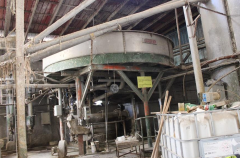 TT-7997 MG PAPER AND HEAVY TISSUE MACHINE, 18GSM TO 180GSM, WIDTH 2250mm, YEAR 1980 UPDATED 1996TT-7997 MG PAPER AND HEAVY TISSUE MACHINE, 18GSM TO 180GSM, WIDTH 2250mm, YEAR 1980 UPDATED 1996 1. MG PAPER AND HEAVY TISSUE MACHINE 2. PRODUCTION FROM 18GSM TO 180GSM BY WASTEPAPER 3. FOURDRINIER MACHINE MADE IN 1980 - UPDATED IN 1996 - STILL WORKING. 4. NET WIDTH AT THE REWINDER 2250mm 5. STOCK PREPARATION FOR 100% RECYCLED PAPER. 6. CAPACITY 60 TONS/DAYS 7. PAPER FROM 18GSM TO 180GSM 8. REWINDER INCLUDED WITH TO UNWINDER. 9. CONVERTING LINE FOR BAGS AND FOR FOOD-PAPER WITH PLASTIC FILM. QUANTITY: 1 Learn More
 -
 TT-7913 SIEMENS SST-300 COMPLETE STEAM POWER GENERATOR, 20.29 MW, YEAR 2021, 50HzTT-7913 SIEMENS SST-300 COMPLETE STEAM POWER GENERATOR, 20.29 MW, YEAR 2021, 50Hz 1. UNPACKED - STILL BOXED AND CRATED - COMPLETE PLANT 2. NEW UNUSED 3. MODEL: SIEMENS SST-300 4. YEAR OF MANUFACTURE: 2021 Learn More
 -
 TT-7587 SIEMENS TG50D5/W701DS GAS TURBINE GENERATOR, 127.8 MW, YEAR 1995TT-7587 SIEMENS TG50D5/W701DS GAS TURBINE GENERATOR, 127.8 MW, YEAR 1995 1. SIEMENS WESTINGHOUSE TG50D5/W701DS 127.8 MW GAS TURBINE GENERATOR PACKAGES FOR SALE. THE TURBINE PACKAGES TOGETHER OFFER 255 MW READY TO SHIP EQUIPMENT. THIS TECHNOLOGY IS ONE OF THE MOST WIDESPREAD MIDDLE SIZE ENGINES (100-104 MW) FOR POWER GENERATION AND THE ONLY TURBINE OF ITS SIZE THAT CAN OPERATE ON HEAVY FUEL OIL (HFO). 2. THE UNITS ARE OFFERED WITH SOME OF THE REQUIRED BALANCE OF PLANT BY SEPARATE NEGOTIATION. 3. THESE UNITS WERE INSTALLED AND OPERATED IN A POWER STATION FROM 1996 UNTIL THE END OF 2004, WHEN THEY WERE DISMANTLED AS THE RESULT OF A PLANT UPGRADE. THE UNITS WERE PURCHASED AND UPGRADED BY THE BUYER TO 127.8 MW NOMINAL CAPACITY EACH. THEY ALSO FULLY REFURBISHED THE UNITS TO ZERO HOURS. THE TURBINES HAVE THE CAPABILITY OF BEING ABLE TO SWITCH BETWEEN NATURAL GAS AND LIQUID FUEL WHILE STILL OPERATING UNDER LOAD. QUANTITY: 2 Learn More
 -
 TT-6394 FILLING LINE ENOBERG FOR GLASS AND PET BOTTLES 1300 BPH, YEAR 2016TT-6394 FILLING LINE ENOBERG FOR GLASS AND PET BOTTLES 1300 BPH, YEAR 2016 1. SPEED: 1300 BOTTLES/HOUR 2. CONTAINERS: GLASS, PET 3. FORMATS: 0.15 L, 0.50 L 4. PRODUCT: WATER (SPARKLING), WATER (STILL) 5. FILL TYPE: ISOBARIC 6. CARBONISER EMRICH YEAR 2016 QUANTITY: 1 Learn More
 -
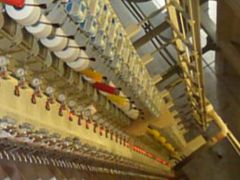 TT-2820 RITE ASSEMBLING WINDER AND VOLKMANN TWO FOR ONE TWISTER, YEAR 1991 TO 1996TT-2820 RITE ASSEMBLING WINDER AND VOLKMANN TWO FOR ONE TWISTER, YEAR 1991 TO 1996 ITEM 001 ASSEMBLING WINDER, RITE/ITALY, TYPE AER-L YEAR 1994 QUANTITY: 1 ITEM 002 ASSEMBLING WINDER, RITE/ITALY, TYPE AER-L YEAR 1994 QUANTITY: 1 ITEM 003 ASSEMBLING WINDER RITE/ITALY, TYPE AER-L YEAR 1996 QUANTITY: 1 ITEM 004 VOLKMANN TWO FOR ONE TWISTER, STILL COMPLETE ON FLOOR YEAR 1991 QUANTITY: 5 Learn More