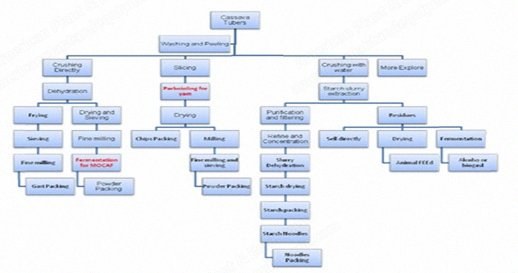
Cassava is a sub-shrub, perennial plant with cylindrical tuberous roots of different varieties, varying in tuber number and thickness.
The cassava root contains a high amount of starch, especially rich in amylopectin, and mainly contains proteins, fat, fiber, and ash.
Starch in fresh cassava tubers is up to 25-32%, and in dry tubers above 70%.
Cassava usually adopts to 15°C or above temperature; based on different HCN content, the bitter level is different.
Tapioca processing is a physical process that removes harmful factors to produce edible grade product.
Cassava starch is popularly used in the starch noodle and sheets industry.
Key Points
Many clients own several hectares of tapioca farm, but cassava can be harvested all year round; harvest along with machinery processing to keep the content in cassava tubers.
This process is called fresh tubers process; you can also make chips first.
When sending an inquiry, provide details on farm size, planned factory location condition including size, and your plan including budget.
Washing And Peeling Section
Washing lifter WSL4130: overall size 4.3m, setting up weight 474 kg, power 1.1-3 kW LV4 (380V, 50Hz as default). Usually works with a big feed to load materials with fork; water runs up to down to make the screwing material clean and cut some long tubers. For small scale, using a bigger one is okay; you can clean the tubers several times using one machine.
Washing machine-brush paddle type PDW350: overall size 4350x850x1000 mm, setting up weight 400 kg, connected power 3 to 4 kW LV6. Paddles rotating with water in the U tube; brushes on paddles make it more workable; longer tubers cut along with rotating. Most valuable washing machine for tubers; usually 2 sets to keep material clean enough in a line.
Washing machine-single cage type CWL6002: overall size 4400x1000x1280 mm, setting up weight 410 kg, power 2.2 to 3 kW LV6. 2 ways of washing length reach to 20m washing and lifting material to the next stage automatically. An alternative to CWL6000.
Washing peeler-brush type BWM120: weight 150, size 1900x850x850 mm, power 1.5 to 3 kW. Screw to control speed, brush to peel tuberous material. Tapioca skin is wood, so shorter brush type peeler is not suitable; potato, sweet potato is preferred.
Washing peeler-drum type WSP6301: 1.5 to 3.0 kW, 300 kg/h max, feeder dia 430 mm, drum dia 630 mm, exit dia 160-100 mm, overall 1010-710-1090 mm, weight 85 kg. Material rotates fast along the wavy and grind arenaceous inner side; water is used to wash the peeled material. Tapioca skin is wood since harvested; longer tubers are not suitable; potato, sweet potato is preferred.
Slicing, Parboiling And Frying Section
Cassava slicer SLR100: overall size 1500x800x3500 mm, power 3 to 6 kW, weight 500 kg. Used for making tuberous material into chips. 3 blades in one plate; reliable continuous work; chips thickness from 1.2 cm to 2.5 cm.
Cassava slicer SLR500: size 1200x400x1200 mm, setting up weight 110 kg, main material SS, processing ability 0.3 to 0.5 tons/hour, power 7.5 kW. Used for making tuberous material into chips. 3 blades in one plate; reliable continuous work; chips thickness from 0.8 mm to 1.5 cm; preferred for belt drying.
Parboiler PBR4000: overall size 4000x1130x1400 mm, setting up weight 800 kg, processing ability 0.5 to 1 ton/hour, power 54.55 kW/380V. Uses steam boiler to exchange heat into water and control water temperature stable to make sure sticky parts are moved for the next stage. Easy speed and temperature control parboiler (for poundo yam, yam blanching machine).
Fryer: power 1.5 kW to 2.2 kW LV6, dia 1200 mm, capacity 0.2 to 0.5 kg/h. Used for gari making in most African countries. 60°C is the temperature needed to control stable; feeder moisture is around 30% to make sure frying efficiency.
Dehydration And Drying Section
Sundryer: 2m height, plates are adjustable, plate size 0.8x0.8 m. Used for chips drying under the sun. This design is used to slash the cost; sundrying needs more labor work and low efficiency.
Starch dehydrator: overall size 1400x1680x1800 mm, setting up weight 526 kg, power 11 LV4, 3 adj. For cassava: 1.5 t/m2/hr; for potato: 0.2 to 0.3 t/m2/hr; output moisture content ≤35%. Used for starch making; not suitable for fufu, gari making.
Hydraulic press: size 800x800x1300 mm, power 2.2 kW, weight 250. Used for flour (fufu, gari) dehydration. Traditional process: milled material is put into bags, several bags placed under the press, then pressed to remove most water; there is large content of starch in the water, so use pipe to collect it.
Request a Quote
✓
Request sent
Thank you, our team will reply to you shortly.
Direct access to our team
Email American Plant & Equipment
Tell us what you want to buy, source, finance, or sell. A machinery specialist will follow up with you.
✓
Thank you. Your request is with the American Plant and Equipment team.
A machinery specialist will follow up with you.
Machinery updates
Subscribe to our email list
Tell us which industries you follow and we will send you the machines that match.
✓
You are on the list.
We will email you when machines that match your interests come in. Unsubscribe from any message.