A new concept for dyeing cellulosic substrates at ultra-low liquor ratios.
Ever increasing demands on textile finishing processes require innovation in machinery as well as in process technology.
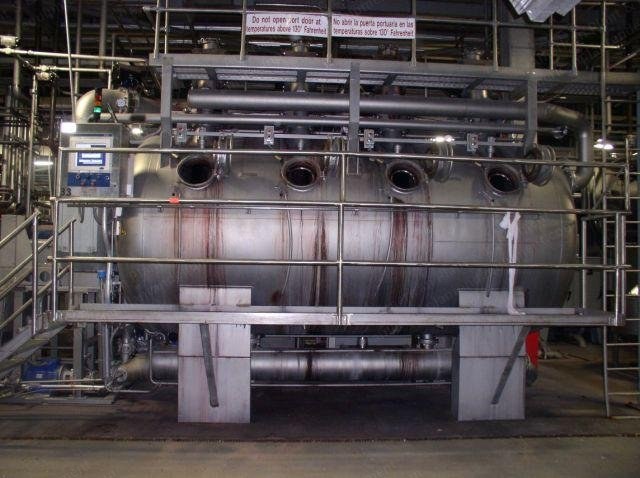
The Luft-Roto Plus, developed by Thies in cooperation with DyStar, is the answer to the recurring demand from dyers for shorter processes which save water and energy.
The starting point for the development of the Luft-Roto Plus was a consideration of how to apply dyestuffs in an exhaust dyeing process, by maintaining the hydrodynamic transport of the fabric, while at the same time optimizing the use of water, energy, chemicals (ecological impact) and time (economic impact).
In today's conventional jet machines, the rope, together with the liquor that transports, is circulated from the jet to the sump.
The liquor that is not retained by the substrate runs off the goods to the bottom of the sump and is then recirculated by a pump.
In the Luft-Roto Plus, a new design concept has been used in which the soft flow jet is positioned on the lifting side of the machine, and a skimming unit before the creel permits an optimization of the carryover of liquor on the goods, and hence an ultra-low liquor ratio.
"Carryover" denotes the liquor retention characteristic of the textile material.
The wet rope is opened by means of an air transport system and plaited in the water-free fabric sump by a synchronized planer (already well known from its use in the Thies Roto-Stream).
The rotating fabric chamber which functions by weight and requires no external drive of the rope, produces a soft handle on the surface of the goods.
This modified liquor circulation process, which means there is no liquor in the fabric sump, produces a free liquor volume of between 200 and 360 L depending on the loading capacity (100 to 180 kg), which leads to very rapid liquor exchange and very short heating times.
Other options such as integrated CCR (combined cooling and rinsing system) analogue dosing, 100% addition tanks, automated salt solution preparation as well as fully automatic machine control permit perfect bleaching and dyeing results with considerable savings of water, energy and time, leading to increased productivity.
Due to its gentle handling of the goods, the Luft-Roto Plus is suitable not only for normal woven and knitted goods, but also for stretch articles that contain a high proportion of elastane.
The dyeing process of water-soluble dyes is characterized by the substantive exhaustion of the dye from the aqueous medium to the textile substrate promoted by the addition of an electrolyte, such as sodium chloride or sodium sulphate.
The following remarks are limited to the consideration of dyeing with reactive dyes.
The exhaustion of the dye and the establishment of an equilibrium between the concentration of the dye on the fiber and the dye in the bath is dependent on the liquor ratio, the quantity of electrolyte, and the substantivity of the dyes.
Normally, this equilibrium is reached after 30 minutes at the dyeing temperature.
By then, depending on the factors mentioned, 30-80% of the dye is exhausted onto the fiber.
Shorter liquor ratios shift the equilibrium in favor of the dye on the fiber, and the equilibrium is also achieved more rapidly.
The alkali required for fixation of the dye is then added portion-wise or by dosing typically over 60 minutes, and the dye is fixed on the fiber by running for a further 30 minutes.
As already mentioned, the goal was to develop an ecologically and economically optimized jet-dyeing machine as well as an optimized process for the dyeing of cellulosic fibers.
With the Luft-Roto Plus, Thies and DyStar have succeeded in building a jet-dyeing machine in which the circulating liquor volume is so low that, in comparison to conventional jet machines, a much shorter dyeing time is possible.
The basic principles of the new process are briefly described as follows.
The dye is pre-dissolved in fresh water or water from the circulating liquor in the machine, half the desired amount of salt is added and then linearly dosed into the machine over a short period.
A short dwell time follows the dosing phase during which time solutions of alkali (preferably soda ash) and the remaining salt may be prepared in the addition tank.
Depending on the process, fresh water or liquor from the circulation in the machine can be used for this.
These solutions are then dosed linearly over a short period into the bath and the dyeing continued for a period of 45-60 minutes.
Finally, the dyeings are rinsed and soaped as usual.
The preferred dye ranges for this process are the medium-high reactivity Levafix or selected Remazol dyes.
In addition, successful trials have been carried out with Procion H-EXL dyes in pale shades.
Load to unload times of 4 hours can be achieved by the process described.
The new process was developed in the Thies Technikum in cooperation with DyStar.
As the volume of circulating liquor is so small and, unlike conventional machines, is not resting in the fabric sump, rapid bath changes and short heating up times are possible.
By positioning the skimming unit before the creel, efficient removal of the unfixed hydrolyzed dye is possible which normally requires longer liquor ratios.
Request a Quote
✓
Request sent
Thank you, our team will reply to you shortly.
Direct access to our team
Email American Plant & Equipment
Tell us what you want to buy, source, finance, or sell. A machinery specialist will follow up with you.
✓
Thank you. Your request is with the American Plant and Equipment team.
A machinery specialist will follow up with you.
Machinery updates
Subscribe to our email list
Tell us which industries you follow and we will send you the machines that match.
✓
You are on the list.
We will email you when machines that match your interests come in. Unsubscribe from any message.