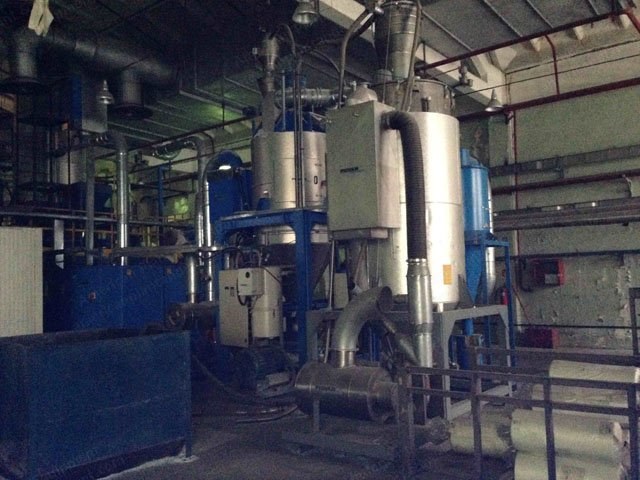
Spunbond Nonwoven Line, 2003, 4500mm Working Width, Polyester Polymer
Scroll to zoom
100%
Description
Overview
Polymer (polyester) in the shape of granules is continuously supplied to the line from big-bags by pneumatic line.
Polyester raw material.
Raw Material Preparation
The granules are crystallized in a crystallizer thanks to temperature and mixing.
Crystallized granules are supplied to the dryer by pneumatic line where removal of excess water out of granules takes place thanks to temperature and dehydration.
Extrusion
The granules are melted in an extruder because of temperature and pressure which are under strict control.
Melted material is supplied by melting line from extruder to spinning beam.
Automatic device for change of filters stops penetration of any foreign materials.
Spinning Beam
Spinning beam consists of a large number of same spinnerets situated along the width of beam and in this way the initial width of non-woven material is defined.
The dosing pumps are installed to provide better supplying of melted polymer to spinnerets.
Then the polymer in a certain proportion is pressed through spinnerets.
Then out coming bundle of fibers from spinnerets is cooled by air flow at set temperature and turbulence free.
When filament is cooled it is stretched via corresponding jets which help to pass it through air flow at high speed.
When filament comes out of jets it passes the system of swinging which defines its distribution on apron.
The apron is the main system where the filament folds out in the form of fabric and moves to the next treatment.
The apron should keep the filament on its location during moving in order to prevent overturn and facilitate its easing before needle punching of fabric.
Needle Punching of Fabric
Non compressed fabric is transferred through two needle punching machines in order to link the fabric.
Thermofixation of Fabric
Perforated drum dryer is thermofixating.
Execution is omega (Ώ), with oil heating and needle rings with passive drive for web linking and its transportation.
Rolls Formation
At the end of the process the fabric is winded into rolls of measured length with facility of cross and longitudinal cutting.
Main Technical Specifications of Spunbond Line
Weight of nonwoven material: min. 110 g/m2, max. 500 g/m2.
Width: up to 4500 mm.
Speed of real production of line: min. 4 m/min., max. 40 m/min.
Crystallizer
Working capacity: 2000 liters.
Storage time: 1.5 h.
Specific air flow: 2 m3/h for kg/h.
Working temperature: 140 up to 150 °C.
Dryer
Working capacity: 7500 liters.
Storage time: from 5 to 6 h.
Specific air flow: more than 3.2 m3/h for kg/h.
Working temperature: 160 up to 180 °C.
Air dew point: < -50 °C.
Productive Capacity of Extruder
Min. 250 kg/h.
Max. 1200 kg/h.
Spinning Beams
Quantity: 2.
Dosing pumps of every spinning beam: quantity 8.
Spinnerets on every spinning beam: quantity 28.
Denier size of typical filament: range from 3 to 6 denier.
Cooler of Fiber
Power: 285000 kcal/h.
Equivalent ≈ 330 kW.
Needle Punch Machines
The first machine: 5000 needles per meter of board width.
The second machine: 10000 needles per meter of board width.
Working width: 4600 mm.
Max frequency: 2000 punches/min.
Max length travel: 30 mm.
Thermofixation Machine
Weight of surface unit: 100 to 300 g/m2.
Production rate: max 30 m/min.
Productivity: max 1700 kg/h.
Working length: 4600 mm.
Drum diameter: 1895 mm.
Temperature of drying: near 220 °C.
Power consumption: 600 kW (516000 kcal/h).
Winder
Fabric weight: 60-500 g/m2.
Rolls diameter: max 1600 mm.
Max rolls weight: 1400 kg.
Max speed: 40 m/min.
Power Consumption
Connection: 3-phase, neutral or ground.
Frequency: 50 Hz.
Voltage: 400 V ±10%.
Additional: 110 V.
Water Consumption
Pressure: 4 to 5 bar.
Max working temperature: 25 °C.
Max total hardness: 33° as per F.
Compressed Air Consumption (Industrial Air Under Pressure) for Service
Flow rate: 120 Nm3/h.
Pressure: 5-6 bars.
Working temperature: 10 to 30 °C.
Max oil content: 20 mg/N for m3.
Compressed Air Consumption for Jets
Absolute pressure: 3.6 bar.
Max working temperature: 35 °C.
Quality: oil free.
Dew point: -20 °C.
Water Consumption (Cooling) for Compressors and Extruder
Average supply in typical working conditions: 30 m3/h.
Compressed Air Consumption for Jets (Additional)
Average supply in typical working conditions: ≈4900 Nm3/h.
Request a Quote
✓
Request sent
Thank you, our team will reply to you shortly.
Direct access to our team
Email American Plant & Equipment
Tell us what you want to buy, source, finance, or sell. A machinery specialist will follow up with you.
✓
Thank you. Your request is with the American Plant and Equipment team.
A machinery specialist will follow up with you.
Machinery updates
Subscribe to our email list
Tell us which industries you follow and we will send you the machines that match.
✓
You are on the list.
We will email you when machines that match your interests come in. Unsubscribe from any message.