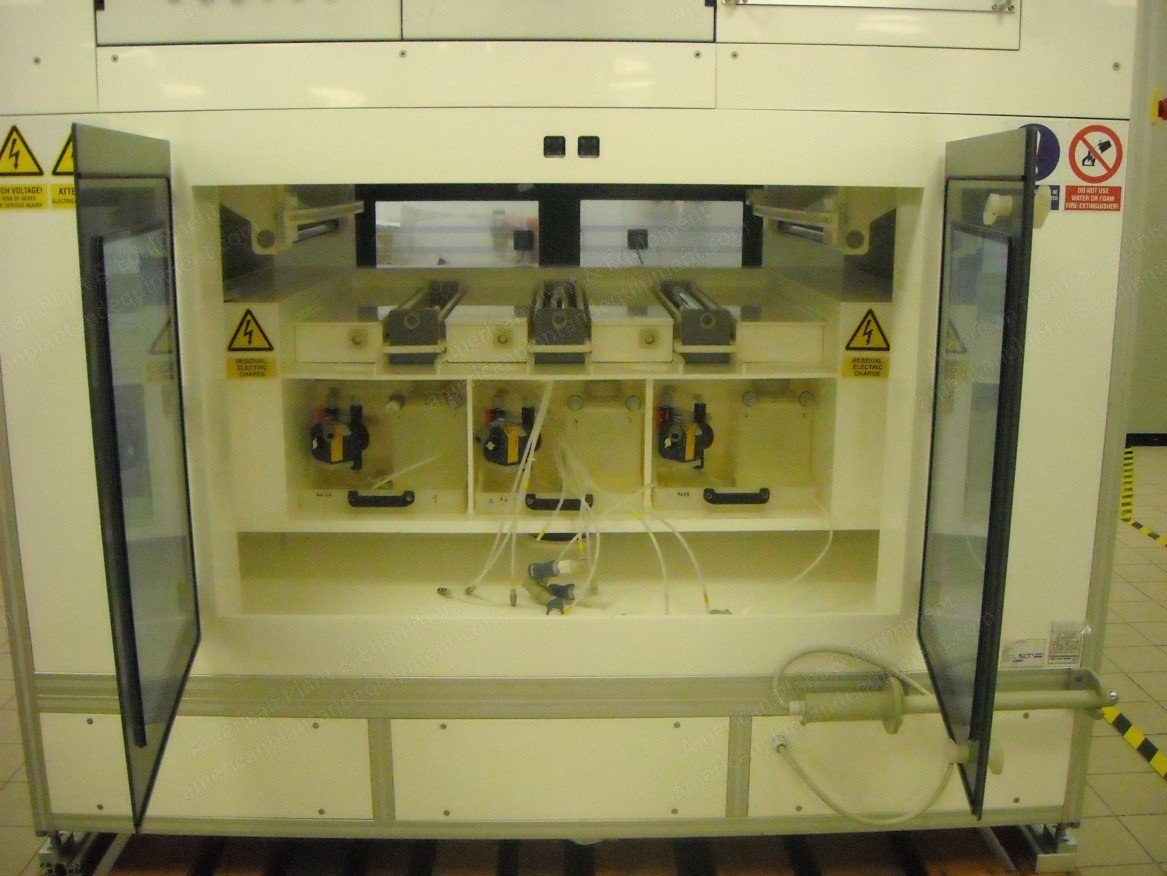
Description Overview Nanos spider production line Model NS 4S1000U Ideal piece of electrospinning equipment for those ready to scale up their process from a lab concept to a high volume industrial production Safe and reliable equipment that delivers cost effective, uniform nanofiber webs Optimized for non water soluble polymers, with minimized usage of solvents Based on Elmarco’s proprietary needle-free electrospinning process, to deliver the performance that your products and customers need Delivers high quality materials in a compact and affordable form factor Small footprint, simplicity easy to fit into your facility Standard connections for easier plant integration Specifications 2 spinning modules 4 spinning electrodes (2 per module) Modules can be operated independently, also with different polymers Spinning electrode width: 1.0 m (configurable between 0.3 to 1.0 m) Spinning voltage: 0 to 140 kV Substrate speed: 0.2 to 12.0 m/min Spinning distance: 140 to 290 mm Meets all CE requirements Height: 2200 mm, length: 2100 mm, width: 2200 mm, weight: 1200 kg 0.3 to 1.0 m effective width of nanofiber layer Four spinning electrode system allows for high throughput Designed for 24 hours / 7 days operation Automatic production control system Throughput example: 0.45 g/min for PA6 on PA spunbond, 150 nm fiber diameter, 1.0 m width High nanofiber web uniformity Low volume polymer system Low solvent consumption Minimized solvent usage Low solvent evaporation Polymer and solvent flexibility Better able to handle volatile solutions Two separate solutions baths Needle-free technology allows easy process optimizations Power consumption: up to 3 kW (without peripherals) Peripherals Polymer mix station Unwind / rewind Air dryer Adhesion pre-treatment Filling and cleaning station Air permeability tester Humidity control Waste air treatment Substrate Maximum width 1100 mm Potential substrates: cellulose, synthetics, fiberglass, foils Sufficient tensile strength, thickness and conductivity necessary Polymers Optimized for non water soluble polymers Commonly used polymers: polyamides, PAN, PES, PSU, PVDF, etc. Fiber Metrics Controlled fiber diameters: approximately 80 to 700 nm Fiber diameter deviations: +/- 30% Basis weight: 0.02 to 4 g/m2 (for a single pass) Process Throughput: depends on polymer, substrate, process, and fiber diameter Example: 0.45 g/min for PA6 Ultramid B24 on PA spunbond, nanofiber layer width: 1.0 m, fiber diameter: 150 nm +/- 25%, spinning voltage: 100 kV, temperature: 22°C, relative humidity: 30% Effective width of nanofiber layer: 0.3 to 1.0 m Working temperature: 20 to 30 °C Working humidity: 20 to 40 % RH (influence on throughput) Cycle Times Operation: 24 hours / 7 days Start up time: up to 20 min Polymer refilling: 10 min Operating mode: batch Volume of solution per batch: 18 L Maintenance Regular maintenance time: total of 15 hours/month (depends on process) Cleaning of spinning components: manually or in a cleaning station Site Operating staff required: 1 person per shift Production premises: 10 m x 10 m space required Recommended dustiness class: ISO class 8 (Fed class 100 000) Connections Voltage supply: adapted for grids in all countries Exhaust ventilation: 2000 m3/hour Appropriate treatment of ventilation waste Compressed air required Inert gas required