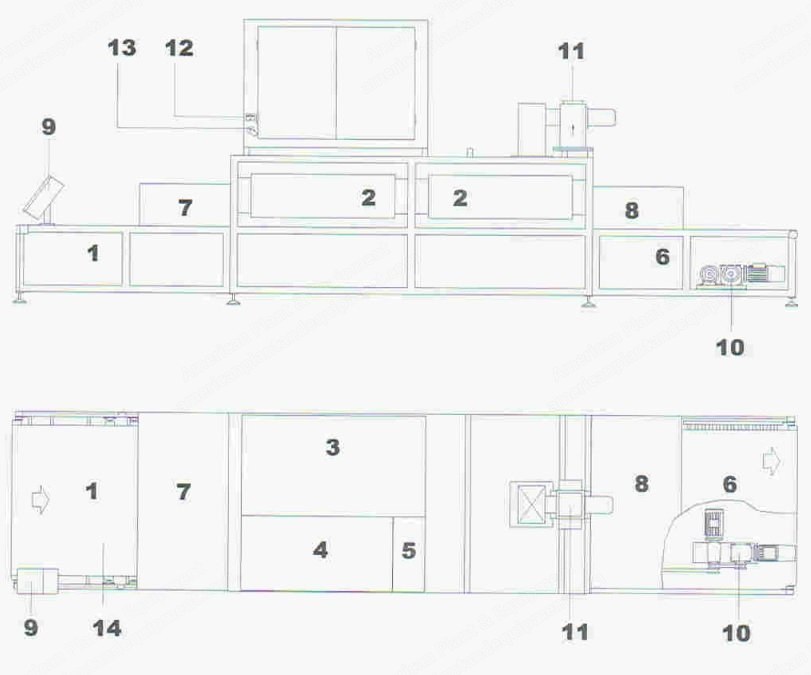
Description Overview Radio frequency dryer for cones Make: Rf Systems Model: Td-85 (K85) Year: 2002 Three phases 380 – 50 Hz For different voltage the machine is equipped with auto transformer The nominal voltage should be within 5% (temporary excursions of +5% and -5% are permitted) otherwise customer must install a suitable stabilizer Maximum power absorbed from the mains: 130 kVA Maximum current absorbed: 210 A Gauge wire: 3x75mm² + ground 50mm² minimum Generator Specifications Maximum power radio frequency generator: 85 kW (1 x 85kW) Work frequency: 27 MHz Cooling system: Forced air Maximum room temperature: Ta = 35°C if higher power must be reduced Maximum exhaust air temperature: Tu = 85°C Oscillator: Cavity type with high overall efficiency Frequency stability: Within limits Radiated field: Within limits Grid current with no load: 2.3 A to 2.5 A Grid current minimum with full load: 1.4 A Triode type: Rs 3060 CL Filament triode voltage: 10 V + 1% - 3% Belt Conveyor Material: Polyester fabric Tracking: Automatic Length: 21600mm Width: 1750mm Range of conveyor speed: 0 to 50 m/ora Electrode: Standard type Productivity Maximum evaporating capacity: 90 kg water per hour Dimensions Length: 9600mm Width: 2124mm Maximum height: 3400mm Gallery length: 4000mm Inlet length: 2800mm Outlet length: 2800mm Belt width: 1750mm Load height: 900mm Maximum height of inlet trap: 300mm The dryer TD85 is composed of one unity of 85 kW Special Requirements On Using Radio Frequency Dryer The dryer can accept only hydroextract goods with even moisture content Possible fire hazard when dealing with unextracted packages Propen hydroextraction is important prior to RF dryer Load product with same dimensions and similar moisture contents Package placement on the belt. Any type of tube may be used in a continued RF dryer Metal tubes require move care in placement on the belt then plastic tube Metal tubes can cause short circuity, or arcing, from one electrode to ground, which can damage the belt or cause fire Package with metal tubes must be placed on the belt so the metal is parallel to the electrodes as shons is ty The conveyor should always be loaded evenly, with no big empty gaps Load as much as you can Good with differents size are not allowed they can get burns Load a quantity of goods with a quantity of water to remove per linear meter of belt around 5 to 15 kg per linear meter of belt The machine cannot accept metallic dystuff (ex.chrome) Do not enter metallic parts Metallic in the gallery causes electrical discharges which may thoroughly ruin belt and set the drying material on fire