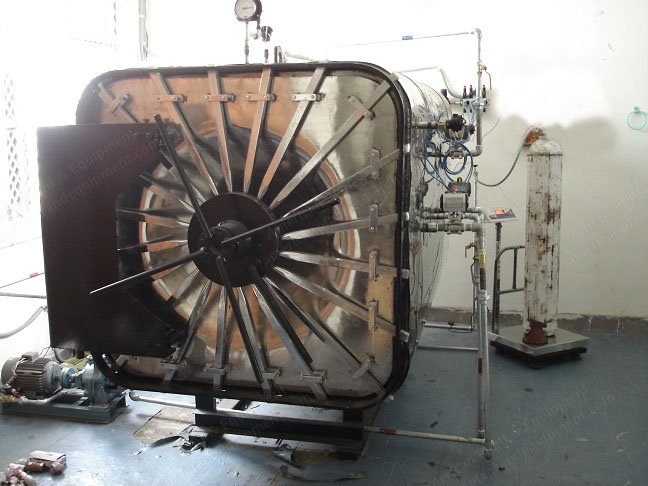
Ethylene oxide (ETO) sterilization is mainly used to sterilize medical and pharmaceutical products that cannot support conventional high temperature steam sterilization – such as devices that incorporate electronic components, plastic packaging, or plastic containers.
ETO gas infiltrates packages as well as products themselves to kill microorganisms that are left during production or packaging process.
This gas, mixed with air at a ratio of at least 3% ETO gas, forms an explosive mixture.
Pure ETO gas boiling point is 10.73°C at atmospheric pressure.
Most of the time, it is mixed with nitrogen or CO2.
This explosive condition requires intrinsic safe material (ATEX) zoning, for security of people as well as security of the process itself.
Safety of personnel is an important issue due to the harmful effect of ETO on humans.
Polluted areas need to be alarmed using gas detectors set up at different locations to monitor any leak.
Visual and audio alarm systems need to be provided.
The system must inform any operator when a sterilization cell contains ETO.
When this toxic gas is removed from the room it needs to be treated using thermal burners, scrubbers or oxidation for environmental protection or be transported to an alternate facility for treatment.
Process
ETO sterilizer offers various distinct advantages over the conventional steam sterilizers, being a dry and cold (operates at 50°C) process proves very useful in sterilization of expensive items.
It has got a unique penetration ability, so it is very useful in sterilization of expensive and delicate items such as cardiac catheters, stents, IOL’s tubing, various types of scopes, sharp surgical instruments, etc.
Its unique mode of action also enhances the life of several surgical accessories and disposable items, thus making them perfectly reusable.
Mode Of Operation
ETO sterilization can be carried out by using gas mixture containing ethylene oxide + carbon dioxide, which is normally available in cylinders.
Below mentioned concentrations are suitable in the equipment: 10% ETO and 90% CO2, or 20% ETO and 80% CO2.
Technical Specifications
Chamber
Internal chamber size: 1220mm x 2000mm x 6300mm (W x H x L)
Overall size: 1500mm x 2600mm x 7000mm (W x H x L)
Internal material of construction: 10mm thick stainless steel #304
Internal finish: Mirror finish
Operating pressure: -20” inch/Hg to 10 psi
Test pressure: 20 psi
Gas options: 10% ETO and 90% CO2, or 20% ETO and 80% CO2
Sterilizer chamber connection ports:
Vacuum port: 50mm round shaft, SS #304
Gas-in port: 38mm round shaft, SS #304
Exhaust port: 50mm round shaft, SS #304
RH inlet port: 32mm round shaft, SS #304
Air inlet port: 32mm round shaft, SS #304
Validation port: 32mm round shaft, SS #304
Sensor port: 32mm/38mm round shaft, SS #304
Chamber comes with all necessary connections to perform the sterilization process.
All piping and connections to the chamber are made from SS #304.
One digital temperature controller to control the chamber temperature and one pressure/vacuum gauge to read the chamber pressure also provided.
One safety valve made from SS #304 is also provided.
Water Jacket
Purpose of jacket: Water circulation
Material of construction: Mild steel
Plate thickness: 8mm mild steel plate
Test pressure: 0.5 kg/cm²
Connections: Water in port = 25mm mild steel; water out port = 25mm mild steel
Outer cover: Company’s hair finish sheet
Insulation: 30mm thick resin-bonded fiber glass wool, insulation is provided with S.S. (18SWG) outer covering
Door
Number of doors: Double
Type of door: Hinged type door with bolt and nut type locking
Material of construction (door): 16mm thick stainless steel 304
Gasket: Solid section silicon gasket
Door hinge: 20mm thick mild steel plate
Finish of door hinge: Auto-paint
Stand: Made from MS C-section channel
Accessories / Utilities
Hot Water Tank
Capacity: 400 liters
Material: SS #304
Thickness: 2mm
Heaters: 6 water immersion heaters, 36 kW (6 kW each) with magnetic float switch for protection
Gas vaporization system: One stainless steel coil is provided in the hot water tank to pre-heat the gas before entering the chamber
Gas Dilution Tank
Capacity: 200 liters
Material of construction: SS #304
Equipped with all of the necessary nozzles and connections
Vacuum Pump
7.5 HP / 3 phase
Water Circulation Pump
1 HP / 3 phase with motor (2 nos.)
Electrical Control Panel
M.S. powder coated panel is provided with all necessary contractors and relays and digital temperature meter with indicators and switches.
Panel equipped with contractors of Siemens, Schneider, L&T or Telemecanique make.
Air Filter
5 micron filter
Gas Circulation System (Optional)
Effective gas circulation during exposure phase, increase the sterility to products.
Pump system 3 HP Crompton make electrical motor.
Puff insulated duck line for effective circulation in the chamber.
PLC automatic (with monitoring and graph system as per ISO 11135 (2007) (optional).
PLC Based Automation Consists Of The Below Features
HMI and PLC process automation
Process automation hardware
Process automation software
Process PLC automatic software
Detailed offerings in PLC based automation system consist of below instruments/features:
PLC For The Process Automation
Ladder logic control of process automation
Process Automation Hardware
Sensors:
Kellner pressure/vacuum compound transducer: 1 (chamber wall mounting) (-1 to 3 bar, 4 to 20mAmp)
Temperature sensors and transmitters: 19 (chamber wall mounting) (3-wire PT-100, 0 to 60°C, -5 to +5VDC)
Relative humidity sensor cum transmitter: 9 (chamber wall mounting) (0 to 100% RH, linear 0.8 to 3.9 VDC)
PLC Delta / Siemens
Digital I/O – 8
Digital O/P – 12
PLC operating “Delta” HMI
Touch screen (10”) panel mounted
On/off control output channels
Digital I/O card (8 channel capacity)
Relay output card (8 channel capacity), to control on/off vacuum, steam inlet, ETO inlet, chamber exhaust, air inlet, water pump, gas circulation and alarm to control the programmed process parameters
Input / output signal control box
All the temperature transmitters are mounted in this box
Power supply to run all the logical input signals and signal conversion devices
Power supply for relay card, 230 V AC signals to the solenoid coils
Front panel with indicator / switch for all the valve operations
Auto/manual operation facility
Auto control air operating pneumatic valve
All the auto control valve 230 AC signals operating
S.S ball valve (6)
Rotex / Festo numeric valve with actuator (5)
With all valve accessories
Process Automation Software
The software is flexible to take care of the sterilization process.
All the cycle parameters like temperature, pressure, vacuum, and time are programmable.
Different combinations can be programmed and named.
Password facility for the security.
During any sterilization cycle following are visible live on the monitor:
A real-time graph of pressure/vacuum & temperature vs time.
Digital and graphical display for temperatures.
A simple cycle operation with a user-friendly interface.
Request a Quote
✓
Request sent
Thank you, our team will reply to you shortly.
Direct access to our team
Email American Plant & Equipment
Tell us what you want to buy, source, finance, or sell. A machinery specialist will follow up with you.
✓
Thank you. Your request is with the American Plant and Equipment team.
A machinery specialist will follow up with you.
Machinery updates
Subscribe to our email list
Tell us which industries you follow and we will send you the machines that match.
✓
You are on the list.
We will email you when machines that match your interests come in. Unsubscribe from any message.