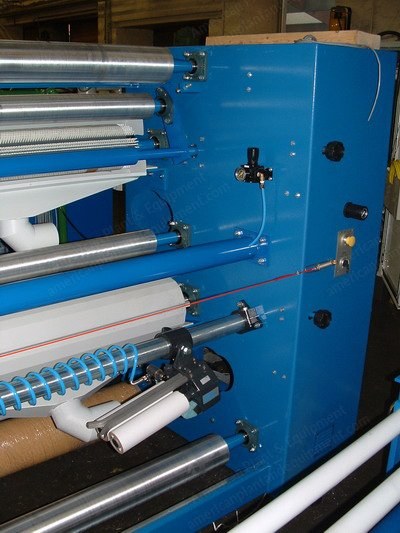
Singeing range FS4 with a working width of 3600 mm.
Latest design includes a Carbomatic touch screen control panel for the entire singeing line.
The control panel allows visualization of all steps from setting under tension to production, and displays all defaults and problems for easy understanding.
The design allows selection of individual modules for particular requirements.
Includes a technical description and approximate drawing nr 50.370-3 for the FS4 model.
Technical Data
Type of machine: Carbomatic line with singeing unit.
Number of burners: 2, for processing both sides.
Feeding speed: 10 to 180 m/min.
Included Modules
Feeding field with J-scray.
Brushing unit.
Dust collection for item 2.
FS4 singeing module (direct burner with 3 positions).
Beating unit.
Dust collection for item 5.
Impregnation vessel.
Mangle.
Batcher.
Folding device.
Electrical cabinet.
Additional Accessories
Carbo control.
Flame width reduction.
Item 001: Feeding Field
Feeding of the machine is made by means of large rolls, pleated pieces, length-folded and pleated pieces.
Special system with J-box allowing non-stop feeding of the line, with electronic control of the weight of the J-box, detectors, etc.
Steel plate chassis, painted.
Adjustable tension device.
Turning bars.
Pneumatic fabric guiders with continuous width setting.
Coated roller driven by AC gear-motor controlled by frequency inverter, with satellite roller, for maximum wrapping.
Oscillating roller with pneumatic compensation and electrically measured position.
Item 002: Brushing Unit
Brushing before singeing achieves raising and equalizing of the nap as well as effective extraction of dust and thread ends.
Fine setting of the action angle for each brush.
Efficiency ensured by tight contact between the fabric and the brushes.
Easy access to the brushes and to the air ducts.
Collection of the dust just where it is produced, instead of sucking it from a complete box.
Welded steel frame, painted.
Two sector brushes, combining a brushing-beating effect.
Brushes driven by gear motors.
Turning rollers.
Profiled dust collectors to ensure efficient dust collection and transport, fitted with protection hoods, hinged for easy cleaning operation.
Hand setting of the brushing effect, independently on each side of the fabric.
Item 003: Dust Collection
Dust filter.
High efficiency centrifugal exhaust fan, connected to the dust filter.
Treated air volume: from 5,600 to 9,000 m³/h depending on the working width.
Item 004: FS4 Singeing Module
Number of burners: 2, 1 per face (type of burner: direct flame).
Fabrics to be singed: cotton, polyester, viscose, blends with synthetics.
Fuel: gas (natural, propane, butane, LPG – to be specified with the order).
Maximum burner heat capacity: 415,000 kJ/h per meter.
Heat capacity variation range: 1 to 5.
Distance from flame (origin) to fabric: adjustable from 10 to 40 mm, in radial position.
Linear fabric speed: 10 to 180 m/min.
Feed-in speed: 10 m/min.
Exhaust gas volume: 1800 to 3100 m³/h depending on the working width.
Standard feed gas pressure: 50 to 150 mbar.
Hoods and protections in accordance with safety and maintenance requirements.
Welded steel frame, painted.
Stainless steel gas exhaust hood.
High capacity exhaust fans for efficient evacuation of gas and steam.
Protection by stainless steel sliding doors.
Stainless steel turning rollers.
2 stainless steel water-cooled singeing rollers, one at each singeing location.
2 direct flame water-cooled burners with high regularity of the flame over the whole width and easy maintenance (no costly ceramics to be replaced).
Pneumatic motion of the burners to or from the fabric.
3 pre-selected burning positions: through the fabric, radial or tangential to the fabric; the position can be different for each burner.
Electric ignition of the burners by means of high-tension transformer and special spark-plugs.
Air-gas feeding unit including: combustion air fan with minimum pressure safety switch and air filter; variation of the caloric power over a frequency inverter; proportional air-gas flow mixer ensuring the stoichiometric proportion for any flame condition; safety devices on the gas feed line (3 micro filters, mini-maxi safety pressure control gauge, safety main and secondary electro-valves); possibility to singe with a single burner.
Cooling circuit with partial water recycling with thermostatic control, holding the preset water temperature during start and working speed to avoid condensation on the singeing rollers; includes a high flow circulating pump (3 to 6 m³/h depending on working width), a heat exchanger with thermostatic control of steam, and mini-maxi water temperature safety control.
2 microprocessors check the firing procedure and control by each burner the presence of the flame by means of UV sensors; in case of flame default, there is an identification of the reason.
Additional accessories: flame width reduction for perfect matching between flame width and fabric width via a motorized width regulation system (500 mm on both sides); carbo control for automatic process regulation control, locking the calorific power of the burners to the post-singeing fabric temperature and comparing to a preset value for perfect repeatability of the singeing effect.
Item 005: Beating Unit
After singeing, beating helps separate the ashes from the fabric, ensuring good bleaching process and avoiding soot in the impregnation vessel.
Fine setting of the action angle for each beater.
Efficiency ensured by tight contact between the fabric and the beaters.
Easy access to the beaters and to the air ducts.
High suction power, eliminating all risks of fire.
Welded steel frame, painted.
Two beating rollers driven by gear motors.
Turning rollers.
Profiled dust collector to ensure efficient ash collection and transport, fitted with protection hoods, hinged for easy cleaning operation.
Hand setting of the beating effect, independently on each side of the fabric.
Draw and turning rollers.
Request a Quote
✓
Request sent
Thank you, our team will reply to you shortly.
Direct access to our team
Email American Plant & Equipment
Tell us what you want to buy, source, finance, or sell. A machinery specialist will follow up with you.
✓
Thank you. Your request is with the American Plant and Equipment team.
A machinery specialist will follow up with you.
Machinery updates
Subscribe to our email list
Tell us which industries you follow and we will send you the machines that match.
✓
You are on the list.
We will email you when machines that match your interests come in. Unsubscribe from any message.