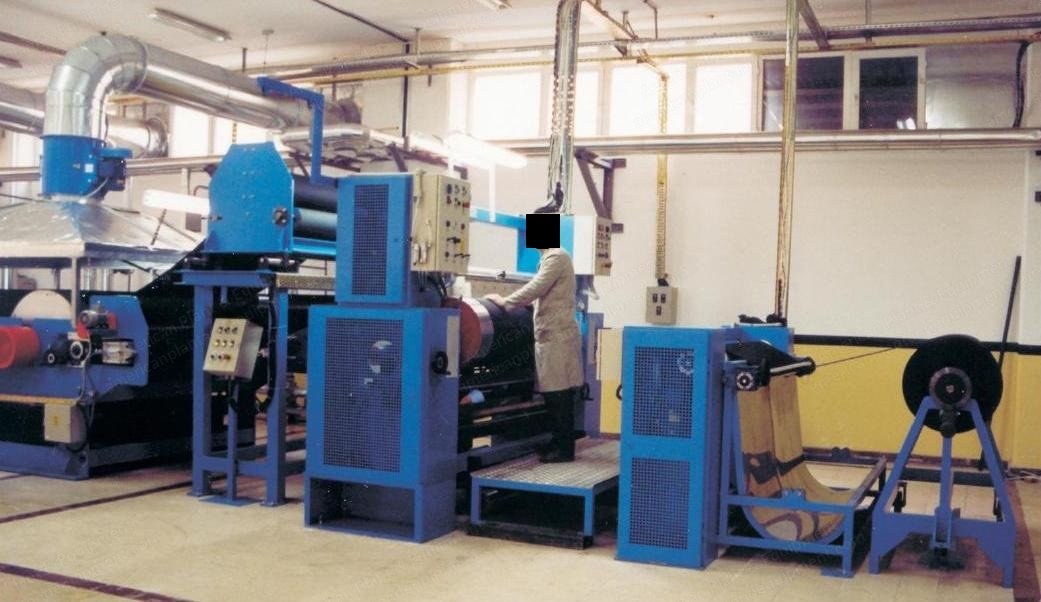
Aigle, AT2, 1999, Direct Coating and Laminating Line, 1850mm Working Width, 400V
Scroll to zoom
100%
Description
Overview
Direct coating and laminating line
Brand: Aigle
Model: Laminating line mod. AT2
Year: 1999 to 2001
Working width: 1850 mm
Specifications
Power supply: 400 V / 50 Hz / three-phase
Installed power: 5 kW
Compressed air: 7 ± 1 kg/cm²
Cylinders heating: diathermic oil
Diathermic oil temperature: 280 °C
Unwinding Group Mod. UT2/AS
Unwinding trolley for large rolls mod. UT2
Axial unwinder mod. AS with universal fast joint for unwinding trolley connection
Coating Head Mod. BS2
Designed and built so that different coating techniques can be employed (see relevant leaflet)
Lamination Unit Mod. AT2
Unwinding group to pull the material requiring lamination without tension
Lamination unit consisting of:
Two cylinders heated with diathermic oil (Ø 2000 mm)
Stainless steel surface, covered in Teflon
One lamination rubber cylinder (Ø 200 mm) opposite to the first cylinder
Cylinder motion obtained through a pneumatic piston with adjustable pressure and equipped with motorized micrometric adjustment of lamination thickness
Two release idle cylinders opposite to the two main cylinders
Idle cylinders to pass material
Unit driven by an A.C. motor with inverter and potentiometer for line synchronization
Equipped with a pump for oil circulation and thermoregulation
Rewinding Group Mod. UT2/AS
Rewinding trolley for large rolls mod. UT2
Axial rewinder mod. AS consisting of a lateral supporting structure with asynchronous induction motors
A.C. motorization and control panels mod. QE
Unit for Dry-Coat Process
Moving unwinder mounted on wheels and running on rails; can be placed before the first heating cylinder and unwind material that requires lamination, or after the second heating cylinder and function as a “dry-coat” unit
Calendering unit consisting of:
Counter-cylinder covered in neoprene of adequate hardness
Steel upper calendering cylinder
Pressure between the two rollers controlled by two pneumatic pistons which can be accurately adjusted to obtain uniform pressure all along the width of the table
With complete working case
Request a Quote
✓
Request sent
Thank you, our team will reply to you shortly.
Direct access to our team
Email American Plant & Equipment
Tell us what you want to buy, source, finance, or sell. A machinery specialist will follow up with you.
✓
Thank you. Your request is with the American Plant and Equipment team.
A machinery specialist will follow up with you.
Machinery updates
Subscribe to our email list
Tell us which industries you follow and we will send you the machines that match.
✓
You are on the list.
We will email you when machines that match your interests come in. Unsubscribe from any message.