Oil Producing Refinery, 16000 BPD, Biodiesel, 20.6-Acre Site
Scroll to zoom
100%
Description
Overview
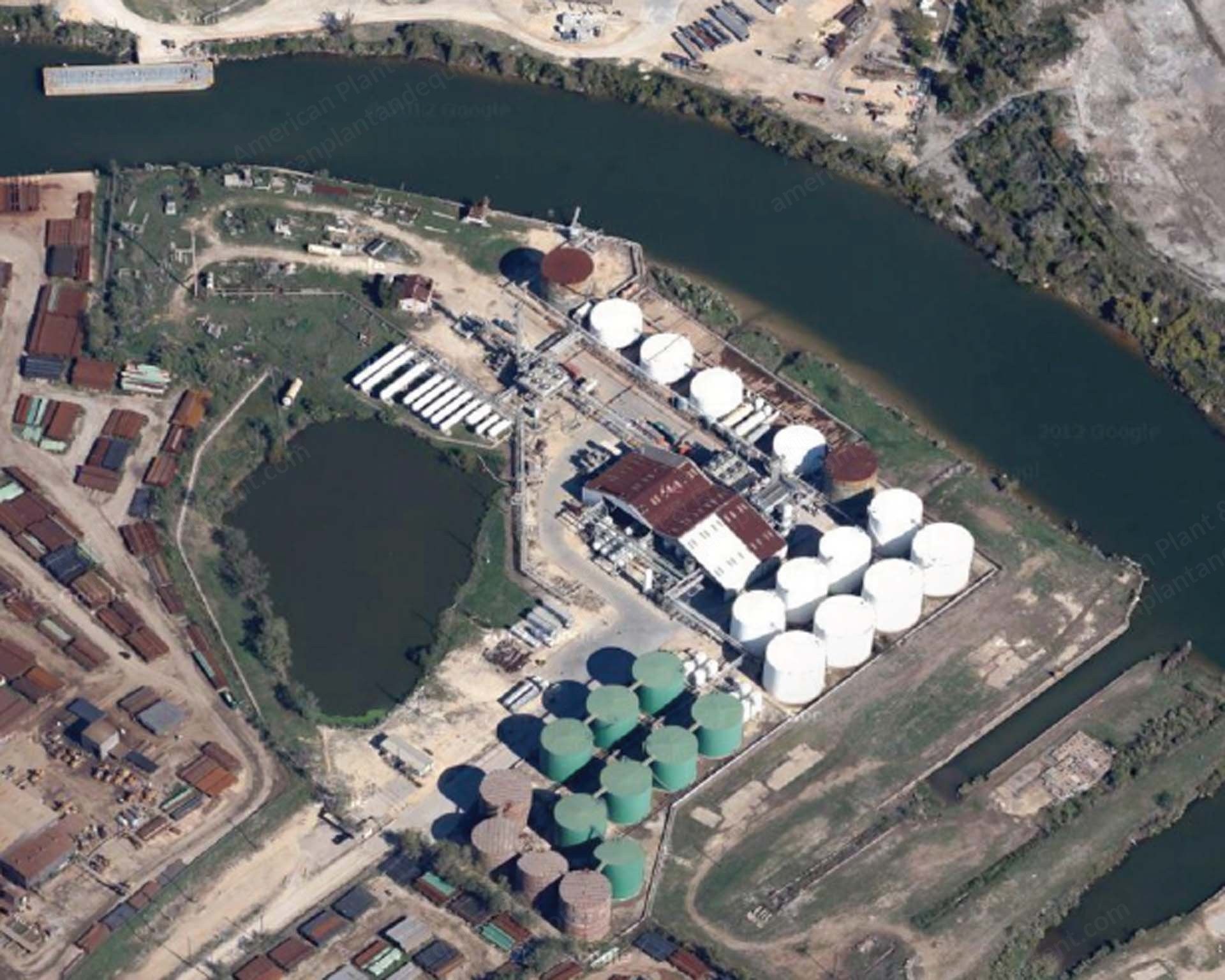
Multi-service processing and terminal facility located on a 20.6-acre site.
Adjacent to an industrial park with unit train capacity that could be built to suit for rail car loading/unloading, as well as deepwater port access.
Roughly 1.5 miles from multiple pipelines.
Originally commissioned in 2007 to build a 110 million gallons/year biodiesel production and storage facility; became operational in 2008.
In late 2009, a combination of storm damage and volatile financial and commodity markets caused the assets to be shut down and placed into receivership.
Originally focused on producing biodiesel; a new ownership group acquired the site in late 2012 and spent significant resources to remediate and upgrade the facilities.
Led to a short test run of full operation in mid 2014 that produced 1.5 million gallons of high purity biodiesel from soybean oil.
In early 2015, uncertain regulatory structure for renewables led management to reposition the refinery to focus on sale of the facilities to a buyer in either the biodiesel or crude industries.
Refining Assets
With modest capital expenditure, capable of first phase splitter throughput of 16,000 barrels/day utilizing two of three existing distillation columns.
An expansion would increase the throughput rate to 36,000 barrels/day with the same two columns; this second phase requires additional logistics and utilities.
Since the above throughput volumes can be achieved with two of three existing columns, the remaining third column (which requires internals and piping) is available to provide additional revenue generating services.
The remaining column can also be used for an additional product cut(s) on the condensate stream if so desired.
Further phases could increase facility throughput from 66,000 to 108,000 barrels/day.
All estimated volumes have been confirmed by an evaluation conducted in March 2015.
With additional investment in a glycerin system, can produce between 36-40 million gallons/year.
644,000 barrels of bulk liquid storage, with expansion capability of an additional 250,000 barrels.
Summary Report on Refinery
An analysis of the facility’s ability to process light crude condensate with its existing distillation systems was performed in January 2015.
Expected initial throughput rates and those resulting from de-bottlenecking/facility optimization were explored to understand the full capability of currently installed equipment.
The study found no fatal flaws in the proposed splitter application and verified all capital intensive/long lead items for processing light petroleum condensate.
In addition to the columns and condensers that have been reviewed and verified, the study also simulated tray configurations and loading using vendor software.
Initial throughput, with existing utility systems fully utilized, is estimated to be 16,000 barrels/day.
Throughput exceeding 40,000 barrels/day is achievable with the addition of utilities and high capacity column internals.
The debutanizer system (the second of three columns) is fully optimized at a rate of approximately 42,600 barrels/day, with excess capacity remaining on the pre-flash system.
Additionally, the site configuration can be altered to allow for deeper product cuts.
The existing hot oil and aerial condenser equipment has been validated by the study; at the initial rate of 16,000 barrels/day there are excess capacities in both hot oil and product condensers.
Location and Logistics
The facility has 1,500 feet of frontage on a navigable waterway that connects with the main ship channel.
The existing barge loading terminal can accommodate vessels of up to 30,000 barrels, and with dredging of approximately 4,300 cubic yards in the navigable waterway could service barges of up to 50,000 barrels, regardless of tidal conditions.
Truck loading that can be augmented as needed by a modularly designed truck rack system.
The refinery has had extensive discussions about a product line interconnection with the adjacent industrial park, which has existing underutilized unit train capacity that is two thirds of a mile from the fence line along a road owned by the refinery.
The connection can accommodate multiple products, with both shared and dedicated lines, depending on the material and customer needs.
The refinery has received a firm bid and timeline for the construction of the product line to the industrial park.
The refinery has established a route through the industrial park from the proposed interconnect to reach the deepwater dock on the main ship channel, two of five berths of which is currently being converted to liquids.
Pipeline interconnection capability with numerous lines approximately 1.5 miles from refinery, primarily along an existing right-of-way.
Terminal Tank Configuration
Total storage capacity of 644,000 barrels, made up of 34 carbon steel tanks in four different sizes: 18 tanks of 25,000 barrels each, 4 tanks of 35,000 barrels each, 4 tanks of 12,500 barrels each, and 8 tanks of 500 barrels each.
Permitting and Environmental Compliance
Two independent contractors performed phase one environmental studies in 2009 and again in 2012, with no significant findings.
The water in the on-site pond is tested annually, and the refinery has performed soil testing in the pond, also with no findings.
The refinery operates with a TCEQ permit by rule that allows for 25 tons of emissions annually, and allows the refinery to store and process material with a vapor pressure up to 11 psia.
The facilities are in full compliance with all known regulatory requirements, including approved facility security plan, SPCC, etc.
Biorefinery / Terminals Condensate Topping Unit Study
This study is to determine the likely capacity of the existing bio-refinery main distillation tower systems to process shale oil crude for separating it into lighter products (like LPG and light naphtha) and stabilized condensate for potential export.
It appears that the main feed fractionation systems (PV-922 and PV-962 towers and their associated reboilers for heat input, and air coolers for lights condensing) can process 16,000 bsd of Eagle Ford crude condensate.
Level 1 capacity is limited by the reboiler size of the 12’ id tower (PV-962) and the total hot oil heater capacity; the total condensate feed rate is limited to 16,000 bpd.
The PV-962 system is adequate to process 16,000 bsd of condensate by itself with some added reboiler surface area.
If one removes the heat input limitations by adding required surface area and hot oil capacity, then the next bottleneck area is the debutanizer tower system (which is the existing 5’ id methanol column system), then even more capacity could be processed.
Level 2 capacity is limited by the debutanizer (existing 5’ id methanol tower) capacity; the limiting factors in level 1 are eliminated.
The capacities of the 5’ id debutanizer and the condensate feed rates are summarized as follows: with conventional trays, debutanizer feed rate of 9,000 bpd and condensate feed rate of 25,600 bpd; with high capacity trays, debutanizer feed rate of 11,600 bpd and condensate feed rate of 33,000 bpd; with ultra high capacity trays, debutanizer feed rate of 15,000 bpd and condensate feed rate of 42,600 bpd; with structured packing, debutanizer feed rate of 9,500 bpd and condensate feed rate of 26,900 bpd.
Request a Quote
✓
Request sent
Thank you, our team will reply to you shortly.
Direct access to our team
Email American Plant & Equipment
Tell us what you want to buy, source, finance, or sell. A machinery specialist will follow up with you.
✓
Thank you. Your request is with the American Plant and Equipment team.
A machinery specialist will follow up with you.
Machinery updates
Subscribe to our email list
Tell us which industries you follow and we will send you the machines that match.
✓
You are on the list.
We will email you when machines that match your interests come in. Unsubscribe from any message.