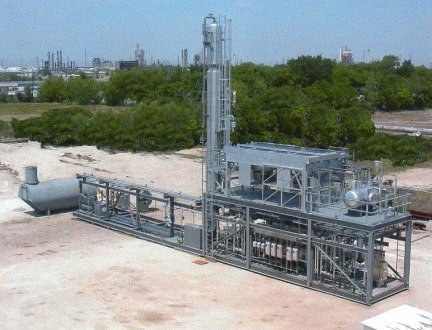
Mini Modular Oil Refinery, 1000 to 10000 BPD, Skid Mounted, Crude Oil Distillation Unit
Scroll to zoom
100%
Description
Overview
Mini modular refineries processing 1,000 to 10,000 barrels per day (BPD).
Skid mounted, modular crude oil distillation units (CDU).
Process from 50,000 to 500,000 metric tons (1,000–10,000 BPD) of crude oil per year.
Capable of producing naphtha (straight run gasoline), kerosene, arctic and summer diesel, and fuel oil.
Two or more plants can be installed on a single site for simultaneous processing of more than one type of crude oil.
One plant can remain in operation if another plant has a breakdown.
Key Features
Can be set up and in operation within a very short time after arrival at a site where foundation and storage tanks are in place.
A single operator may restart the plant from a cold start and have it in full operation in less than two hours.
Completely automated; once an operator sets all controlling points, all product temperatures and flows are controlled automatically.
If a product specification drifts off or a potentially hazardous condition develops, the plant automatically adjusts to a safe condition without operator help.
A “first out” annunciator signals the reason for shutdown by a flashing red light.
Only a flat support area or concrete slab without anchor bolts is required to support the plant.
Requires no water, steam, or instrument air.
Fuel supply can be off-gas, natural gas, naphtha, diesel fuel oil, or a combination of these fuels.
Optional Equipment
Special alloy(s) may be included in the plant design.
De-salter packages for removing salt from the crude.
Naphtha, jet fuel, and diesel hydrotreaters for removing sulphur from the products.
Reformers for producing high octane gasoline motor fuels (10,000 BPD+).
Gasoline stabilizers for reducing the Reid vapor pressure of motor fuels.
Asphalt vacuum units for producing U.S. specification AC-10 asphalt.
Winterized skids for operation in arctic weather.
Portable laboratory and control buildings with supplies.
Applications
Traditionally, large-scale refineries are constructed at centralized locations, supplied via pipeline and transport truck.
Most new hydrocarbon discoveries occur in areas with limited or no infrastructure for transportation and refining.
Producers can construct expensive infrastructure or a new refinery near the production site, which can take several years.
In populated areas near a pipeline or oil field but not near a refinery, a small mini refinery can be installed to process crude from the pipeline.
The plant can “thief the diesel” or desired distillate for local consumption and inject the unused portion of the crude back into the pipeline.
Modular Refinery Components
Atmospheric distillation unit (ADU) or topping plant.
Air-cooled fin fans so no water is required for cooling.
Instrument air compressor if required after final design.
Furnace with a single or multi-burner management system with a high pressure burner feed pump to atomize the fuel for the burner system.
All fuel for running the furnace will be produced by the refining process, except during black start.
PLC/PAC computer based control system for the balance of plant.
Multipurpose distillation column to fractionate a wide range of crude oil and crude oil blends.
Final equipment design and calculations for refined product yields require a complete assay for the crude oil to be used as feedstock.
Design Evolution and Special Features
The first mini-refinery was installed thirty years ago as a 1,000 BPD plant on a single skid with an electric generator, a horizontally mounted tower for hand cranking to vertical position, and permanently mounted hand jacks for jacking the skid off a truck.
Over time, plants stayed in the same location for years, sites had to be larger to support other facilities, and cranes became available, so hand jacks are not required.
Multiple skids are now used to allow more room for operating equipment; skids can be assembled and tested in the shop and reassembled by crane at the site without the need for welders or special technicians.
A recent development in process design allows elimination of level control valves, level controllers, gauge glasses, some pumps, and all associated piping, electrical, instrumentation, and spare parts, substantially reducing plant requirements for operation and maintenance.
Completely automated for self-operation and self-monitoring; if a potentially hazardous situation develops, the plant automatically shuts down and the “first-out” annunciator signals the operator the reason for the shutdown.
Enclosed control room and lab space.
Request a Quote
✓
Request sent
Thank you, our team will reply to you shortly.
Direct access to our team
Email American Plant & Equipment
Tell us what you want to buy, source, finance, or sell. A machinery specialist will follow up with you.
✓
Thank you. Your request is with the American Plant and Equipment team.
A machinery specialist will follow up with you.
Machinery updates
Subscribe to our email list
Tell us which industries you follow and we will send you the machines that match.
✓
You are on the list.
We will email you when machines that match your interests come in. Unsubscribe from any message.