The actual throughput obtained with a given product may vary from the above nominal data depending on materials processed, desired quality parameters and other such requisites.
Granule bulk density: 0.500 - 0.550 kg/L ASTM D 1895.
Melting point: 160 - 168°C (DSC) ASTM D 3415.
Melt flow index (MFI): 1.5-4 ASTM D 1238 L (2.5 kg, 230°C, 10 min).
MFI variation from batch to batch: 5%.
Ash content: < 300 ppm.
Atactic content minimum: < 6% > 3.5% solubility in xylene.
Moisture content max.: 0.1% weight.
Skin layer: polypropylene random copolymer, BOPP grade.
Density: 0.900 - 0.905 ASTM D 1505.
Granule bulk density: 0.500 - 0.550 kg/L ASTM D 1895.
Melting point: 127 - 140°C ASTM D 3415 (DSC).
Melt flow index (MFI): 5-7.5 ASTM D 1238 L (2.16 kg, 230°C, 10 min).
MFI variation from batch to batch: 5%.
Moisture content max.: 0.1% weight.
Additives: major additives are anti-blocking and slipping agent on PP homopolymer matrix and PP random copolymer matrix. Specifications of additives used depend on film type made and actual end use.
Recycled material: the equipment is designed to accept in the core layer up to 40% (depending on film thickness) of recycled material in form of ground edge trim (reprocessed in line) and regranulated film scraps.
Process Definition
The equipment is designed to produce high quality BOPP film by use of the best state of the art process.
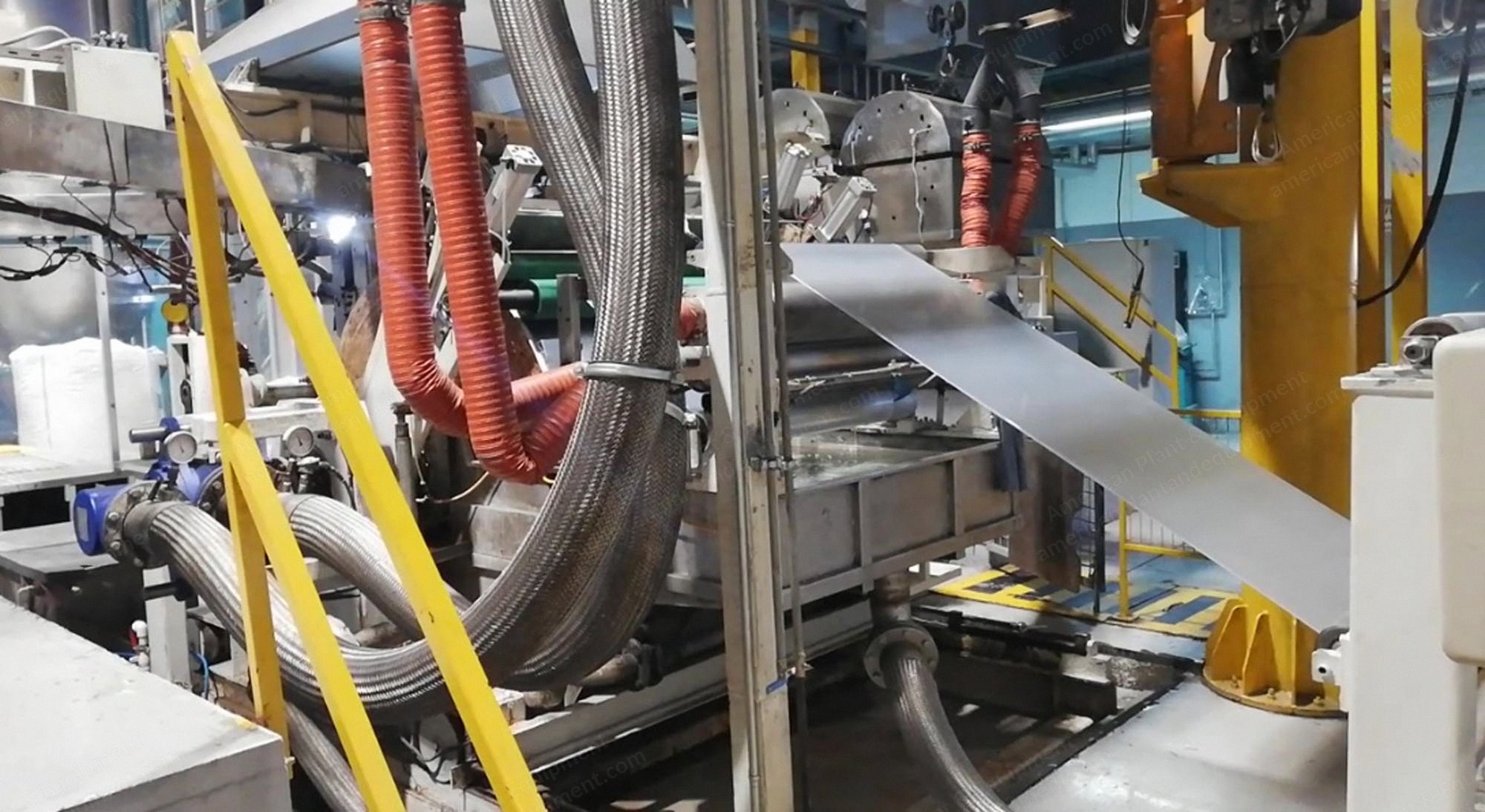
The main process steps are coextrusion of primary film by triple manifold die, followed by symmetric quenching of extruded film on chill roll with outside water bath, sequential MD and TD stretching, edge trimming with in line reprocessing, corona treatment and winding.
A fully integrated monitoring of all process parameters by computerized process control (C.P.C) combined with in line thickness measurement and automatic die control (A.D.C) provides outstanding consistency of the film properties and improved thickness tolerance.
Because of its versatility, the equipment is capable of producing all the ranges of film presently available worldwide in the thickness range and throughput indicated in the present description.
Full process technology as well as detailed information on the main formulations are available for our customers.
The adjustment range of all important process parameters is wide enough to be adapted to almost all known process conditions. Customers having their own process may therefore use the equipment without changing their process parameters and will benefit of the extremely high production reliability and consistency of the film properties resulting from the equipment design.
They will note that even when using the same raw material formulation and the same process conditions as on their other lines, the film produced with our equipment will show higher mechanical properties, better transparency, improved thickness tolerance and lower shrinkage value. The production yield will be improved, production period without film break up to 5 days may be achieved. After film break, standard running conditions will be re-established within few minutes, allowing a perfect functioning of the automatic die control system.
The consumption of energy will be lower than with their existing lines.
Manufacturing Principle
Because a film line incorporates a very large number of individual components using different manufacturing technologies, the optimum manufacturing approach is to have a large percentage of the components sub-contracted or procured from specialized makers before being assembled in individual machines or complete turn-key line.
The selection of sub-contractors and/or suppliers having high quality standards, appropriate machines, a wide experience of this type of line, is therefore essential for the quality of the provided equipment.
Sub-Contractors
All the components produced on our own proprietary drawings are made by a permanent network of manufacturers having been selected for more than 10 years and having manufacturing experience of similar components used in more than 100 film lines around the world. All these sub-contractors are equipped with the most modern specialized machines capable of manufacturing:
Casting roll (max. ∅ 5000 mm).
Max. width: 9000 mm.
Clips: max. yearly production: 100,000 pieces.
Oven: max. 12 000 mm.
Winder frame max. width 8500 mm (film).
Pull roll stand frame (max. width: 9900 mm).
For some sensitive pieces, such as large size filter body, melt pipe, casting roll outside shell or monorail for the TDO, specially made allied steels are necessary. These materials are supplied.
Request a Quote
✓
Request sent
Thank you, our team will reply to you shortly.
Direct access to our team
Email American Plant & Equipment
Tell us what you want to buy, source, finance, or sell. A machinery specialist will follow up with you.
✓
Thank you. Your request is with the American Plant and Equipment team.
A machinery specialist will follow up with you.
Machinery updates
Subscribe to our email list
Tell us which industries you follow and we will send you the machines that match.
✓
You are on the list.
We will email you when machines that match your interests come in. Unsubscribe from any message.