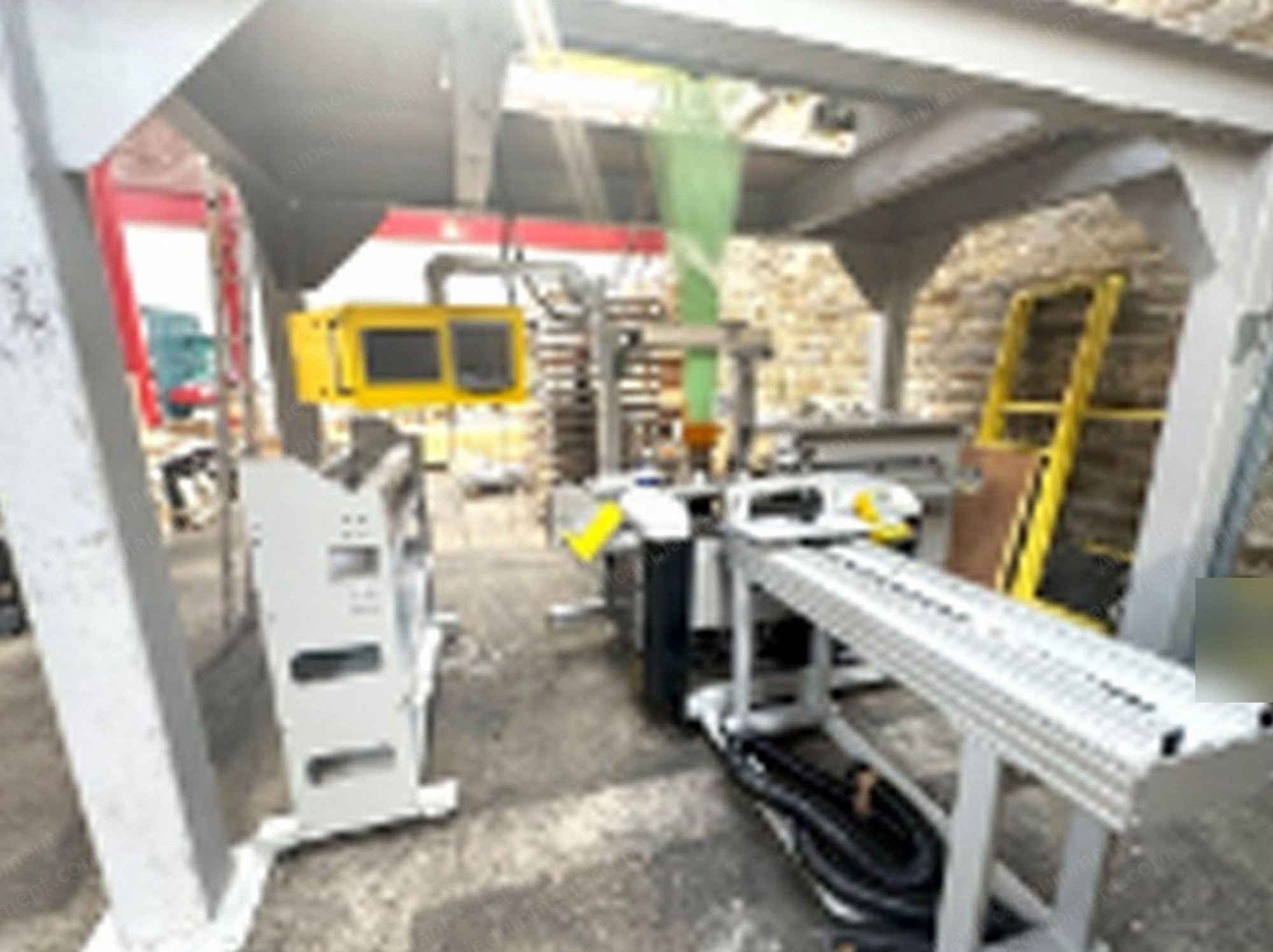
3d single shuttle jacquard weaving machine, ideal for use in r&d and academic laboratories.
Ex-demo 3d loom.
Brand: Optima 3d.
Year: 2019.
Fabric application: many fabrics associated with carbon/glass fibre composite materials.
This loom is excellent for academic research and r&d labs.
Loom Specifications
Single shuttle weft insertion.
Oblique reed motion.
Maximum fabric width: 400 mm.
Fabric take-up via linear table (could be converted to twin roller).
Picks per minute: 40.
Fabric thickness: up to 50 mm.
Jacquard
Staubli LX 3072 capacity, with 1152 hooks fitted (further hooks can be added at a later stage if required).
Jacquard brand: Staubli LX.
Jacquard hooks: 1152.
Harness Setup
Currently the loom is set up to weave 152 mm fabric width, with 38 epcm x 152 mm = 576 total ends.
Maximum fabric width: 400 mm.
576 working ends.
Jacquard Support Gantry
If the current gantry is too high, we can supply a new gantry to fit your building specs.
If the new gantry is required, then you would have to get a new harness.
Technical Description
Optima 3d explanation of 3d woven fabrics and applications.
Optima's series “s” machines embrace cutting-edge digital technology, deployed in concept and execution.
The sophisticated software programme forms a digital platform for the control of cutting-edge servo drive systems on every function of the machine.
The digital platform enables communication with external production analysis systems, digital archiving which ensures repeatability of weave pattern and machine setting data, including remote online access for service and software upgrading.
Optima 3d - series sj-600-4 is a 4 shuttle weaving machine which can be utilised with integrated jacquard or dobby shedding formats.
We also offer this machine in rigid rapier format where the weft/filling is inserted and cut at each side of the fabric; this format is used when the selvedge or edge of the fabric does not need the structural integrity of the continuous weft/filling at the edge of the fabric.
The series “s” machine is capable of producing fabric widths from 50 mm up to 600 mm, and fabric thickness from 3 mm up to 50 mm.
The series “s” machine can be used to weave a comprehensive range of 3d net shapes, para beams and multi-layer billet textile architectures from a range of raw materials including carbon, glass, ceramic, aramid, basalt and silica yarns.
Benefits of 3d Woven Architectures
Many composite architectures are currently made using hand laying techniques, where multiple flat fabrics are glued together in moulds using resin bonding between each layer.
This type of manufacturing method is time consuming and more importantly prone to failure due to delamination or fibre fracture when exposed to impact and resonant forces during high-pressure conditions, which could lead to catastrophic failure of parts and components.
3d woven materials have proved to be very successful due to the binding of each of the multiple-layer and the continuous fibre weft/filling during weaving of the composite material; this system is excellent for producing reinforced components where structural integrity is important at the edge of the fabric.
3d fabric using shuttle weft insertion, where the weft yarn is inserted inside the shuttle forming a continuous yarn through the fabric and edges of the fabric.
3d fabric using rigid rapier, where the weft is positioned outside of the fabric, the rapier picks the weft yarn, which is then cut, then transferred across the fabric where the weft yarn is released creating a fringe at each edge of the fabric.
The blue multi-layer warp yarns are interlaced with the continuous black weft yarn forming multiple layers of fabric; during the formation of the layers a further yellow warp yarn binds all the multiple layers together resulting in a multi-layered fabric which is reinforced throughout the fabric structure.
The number of layers depends on the yarn thickness and yarn density required for various applications.
This billet of fabric is then subject to a process known as rtm (resin transfer moulding) and eventually forms a solid block of reinforced plastic which can be machined to suit the end use application.
3d Weave Adaptability
The principle of multi-layer weave can be adapted to many forms of composite architectures such as 3d net shapes, seamless tubes, para-beams and multi-layer billets.
Aerospace applications: 3d woven net shape (e.g., carbon fibre fan blade which has been 3d woven).
Para-beam: structural beams used in aerospace and other composite engineering applications; the production of these types of architectures uses the origami technique where the 3d structure forms after weaving.
Military and ballistic applications: helicopters and personnel carriers use carbon and glass fibre woven billets installed on the undercarriage for missile and shell protection.
Seamless woven tubes from carbon and glass fibre for various applications.
Emerging applications: the previous example applications are driven by current carbon reduction demands and cost savings.
Aerospace has recognised the advantages of composite materials and the effects on carbon reduction and cost saving.
Military applications also recognise the composite materials advantages when it comes to the protection of life.
We at Optima 3d believe other leading manufacturing markets will soon recognise new areas of application for composite materials.
The fashion textile markets are now looking at seamless garment technology where the use of 3d shuttle weaving has great potential.
Automotive applications call for wider multi-layer fabric widths, mainly used for body panels etc; we at Optima 3d recognise this need and have supplied a prototype machine weaving 1000 mm fabric width to an Italian company who are producing multi-layer fabrics from fibres such as basalt, silica and ceramic used in high temperature seals in the oil and gas industry; the results of which are very encouraging and would expect to increase the fabric width even further.
Request a Quote
✓
Request sent
Thank you, our team will reply to you shortly.
Direct access to our team
Email American Plant & Equipment
Tell us what you want to buy, source, finance, or sell. A machinery specialist will follow up with you.
✓
Thank you. Your request is with the American Plant and Equipment team.
A machinery specialist will follow up with you.
Machinery updates
Subscribe to our email list
Tell us which industries you follow and we will send you the machines that match.
✓
You are on the list.
We will email you when machines that match your interests come in. Unsubscribe from any message.