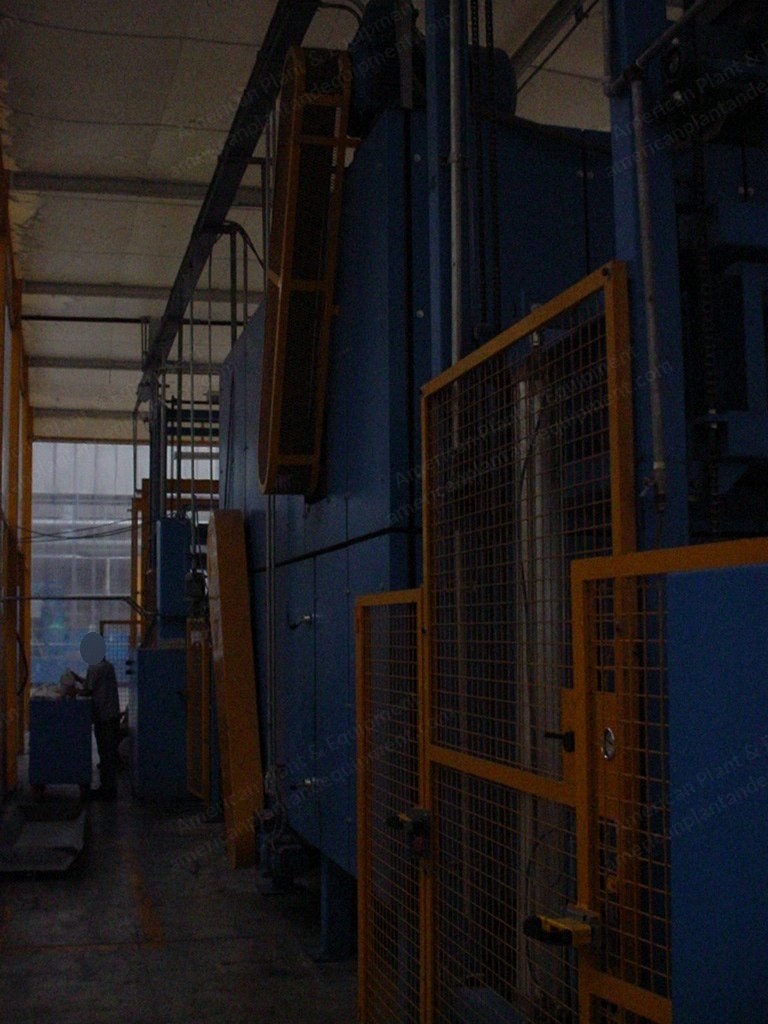
Bombi, Perforated Drum Thru Air Dryer, 2004, 2500mm Width, Gas Heated, 2200mm Drum Diameter
Scroll to zoom
100%
Description
Overview
Bombi perforated drum thru air dryer, gas heated
Line speed: up to 25 m/min, accordingly with the product
Perforated drum dryer diameter: 2200 mm
Gas burner Weishaupt
Metallic transport belt
Year 2004
Width 2500 mm
This dryer was part of our impregnation line which we used to apply resins to our substrates and dry it
Used produced felt with low melt fibers
Used the dryer to activate the fibers
It is a very efficient dryer in a short footprint that it use
Perforated Drum Dryer Specifications
Perforated drum dryer
Drum: nr. 1
Drum diameter: 2200 mm
Heating system: nr. 1 gas burner, modulating type, made by Weishaupt
Thermal power: 500,000 kcal/h
Temp. regulation: with electronic instrument having proportional exit that drive the burner. Instrument is located on the control board, with digital indications
Air temperature: up to 220° C
Electric power: 63 kW
Nonwoven entry: on fiberglass belt that stay in the drum surface
Holes 1.5 x 1.5 mm, “phantom” pin seam
Nonwoven exit: under the oven, on idle rollers
Driving: 3 phases motor frequency converter
Air circulation system: by 1 centrifugal fan equipped with frequency converter, of 55 kW
Air flow sense: suction from the center of the drum and sending on the drum’s surface
Regulation of air flow: with frequency converter that vary the speed of the fan
Air extractor fan: with frequency converter, to adjust the flow
Principle of Working
The nonwoven to be treated stays on one fiberglass belt that carry it on the surface of the drum. Use of the belt is done in order to help the material passing on the big drum and also to limit the possibility of marks (mesh is very fine: 1.5 x 1.5 mm). The belt is Teflon coated so that any risk of gluing is avoided. Belt brings the material on the surface of one rotating perforated drum. One fan sucks the air from the center of the drum and sends the air in one channel, on which is installed the burner. Then, the air is sent on the nonwoven placed on the drum. In this way the air is forced to pass through the nonwoven, highly increasing the real surface of exchange air-nonwoven. This, with the advantage of heating the material in little space and with high efficiency.
Ventilation System
Drum is equipped with recirculating fan for the air forced passing through the nonwoven. The fan is centrifugal type, at high efficiency. The motor is placed outside of the oven with transmission made with belts. The air flow could be regulated with the frequency converter, that also give the advantage of slow speed starting and to optimize the motor absorption (that vary with air temperature).
Heating System
The necessary heat is supplied by nr. 1 direct burner feed with natural gas. Burner is flame modulating type. This means that the flame size is automatically controlled by the electronic instrument fitted on, accordingly with needing (line speed, quantity of fibers etc.). In this way the pre-selected temperature is continuously controlled and regulated, avoiding dangerous temperature jumps. Gas burner is placed in the air channel of the fan. All burner group is placed outside of the oven, and it is possible to make easy maintenance. The temperature is checked by sophisticated electronic thermoregulator, that allow the continuous displaying of real (detected) and pre-selected (set from the operator) temperature. Also it shows burner working and conditions in any moment. It is placed in the control panel.
Control Panel
The electric plant is centralized and it includes:
Line speed display
Fan starting and speed adjusting
Towing motor starting and speed adjusting
Exhaust air fan starting and speed adjusting
Lights for: thermal alarms, overloads, electric line presence
Temperature control
Request a Quote
✓
Request sent
Thank you, our team will reply to you shortly.
Direct access to our team
Email American Plant & Equipment
Tell us what you want to buy, source, finance, or sell. A machinery specialist will follow up with you.
✓
Thank you. Your request is with the American Plant and Equipment team.
A machinery specialist will follow up with you.
Machinery updates
Subscribe to our email list
Tell us which industries you follow and we will send you the machines that match.
✓
You are on the list.
We will email you when machines that match your interests come in. Unsubscribe from any message.