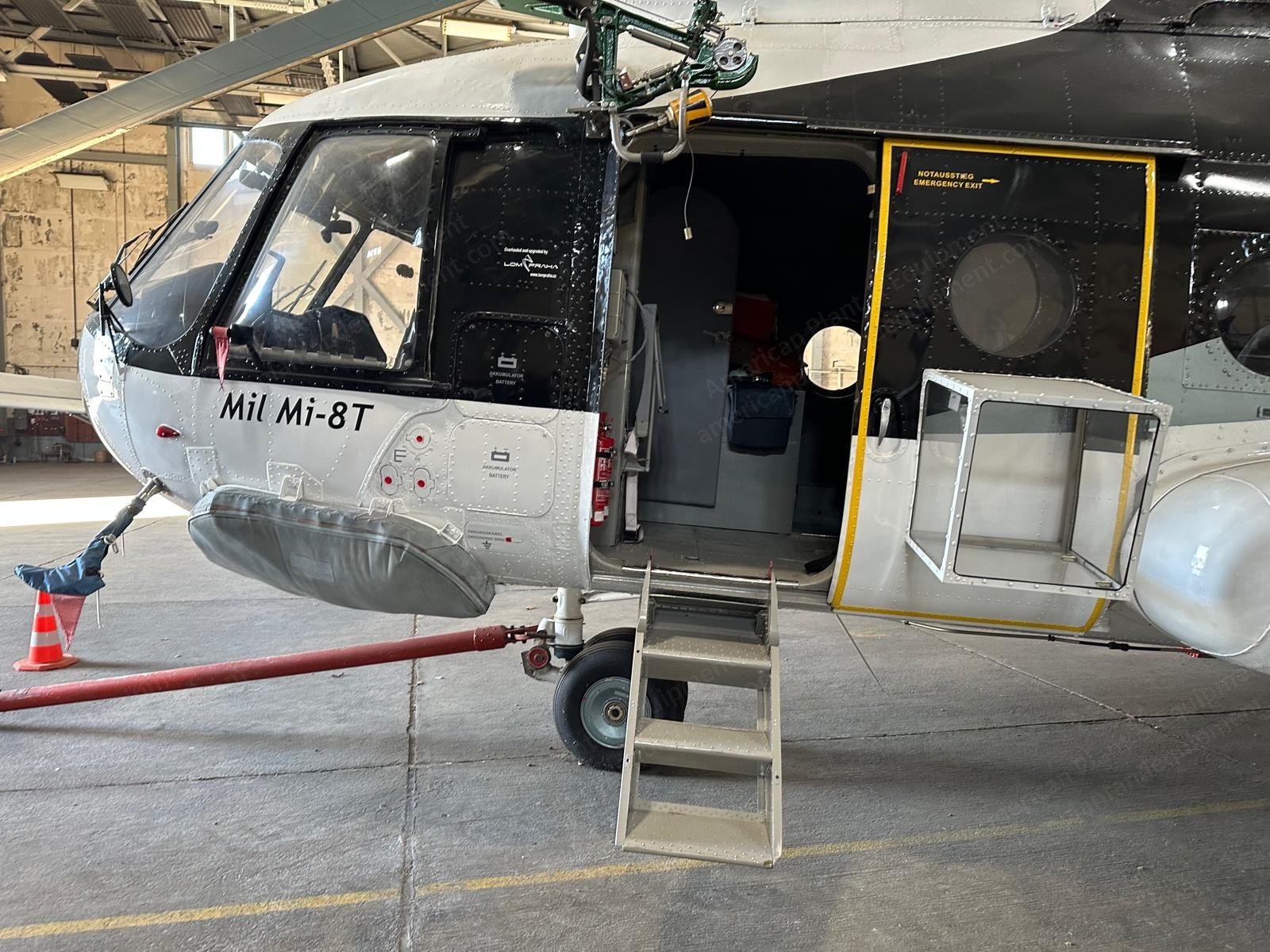
Description Overview Mil Mi-8T medium transport helicopter. Year of manufacture 1974. Overhauled in 2012, with a certificate of release to service available. Flown only a few hours since that overhaul, approximately 60 hours. 21.4 hours since the major overhaul. Total time since new 4,163 hours 32 minutes. Last flight in 2013, with no flight activity in the 13 years since. Calendar items expired in May 2019. Condition described as mint; the aircraft is kept in a hangar. All component data verified as of 24 July 2017. Airframe And Overhaul Status Airframe time since new 4,163 hours 32 minutes. The next airframe overhaul is overdue. Engines and gearboxes overhauled in 2012. Tail rotor system replaced at the 2012 overhaul. No auxiliary power unit is installed. Airframe and dynamic components are described as being in mint condition, suited to continued commercial or governmental operation. Engines Two TV2-117AG turboshaft engines, 1,500 kW (2,012 hp) each. Both engines last overhauled in 2012. Engine 1: 711 hours since new, 22 hours since overhaul, 92 per cent of life remaining. Engine 2: 1,878 hours since new, 22 hours since overhaul, 75 per cent of life remaining. Transmission And Rotor System Main gearbox type VR-8A: 4,141 hours since new, 1,500 hours remaining against a 7,500 hour life limit. Five main rotor blades, part number 8AT.2710.000: 22 hours since new, 1,978 hours remaining. Tail rotor blades: 22 hours since new, 1,478 hours remaining. Tail rotor hub: 22 hours since overhaul, 978 hours remaining against a 4,978 hour limit. Intermediate and tail gearboxes: 4,141 hours since new, 10,859 hours remaining. Three hydraulic boosters, type 8-5301-10: all 22 hours since new, 978 hours remaining. Vibration damper: 978 hours remaining. Swashplate assembly: 8,978 hours remaining. Fan assembly: 12,019 hours remaining. Landing gear struts: 3,987 cycles remaining. Performance Maximum speed 250 km/h (155 mph). Cruising speed 220 km/h (137 mph). Rate of climb 5 to 8 m per second (984 to 1,575 ft per minute). Maximum range 900 km (559 miles). Maximum operating altitude 4,500 m (14,764 ft). Maximum take-off weight 11,900 kg (26,235 lb). Empty weight 6,779 kg (14,945 lb). Maximum load in the cabin 4,000 kg (8,818 lb). Maximum load on the external sling hook 3,000 kg (6,614 lb). Fuel consumption 780 to 800 liters per hour (206 to 211 US gallons per hour) on Jet A-1. Crew of 2 pilots plus 1 flight engineer where applicable, and 16 passengers. Dimensions Overall length 25.244 m (82.8 ft). Fuselage length 18.3 m (60.0 ft). Height 5.65 m (18.5 ft). Main rotor diameter 21.26 m (69.8 ft). Cabin 5.15 m long (16.9 ft), 2.34 m wide (7.7 ft) and 1.82 m high (6.0 ft). Entrance door 1.37 m by 0.82 m (4.5 ft by 2.7 ft). Avionics ELT 406 emergency locator transmitter. Two GTX-330 transponders. Two GNS-530 radio, VOR, ILS and GPS units. KMA-24 intercom with four sockets. KRA-405B radio altimeter. SPEEL PRS-8 cockpit flight data and voice recorder. Third AGB-3K artificial horizon. Equipment And Cabin Operational readiness from -45 C to +45 C (-49 F to 113 F). Sea rescue equipment. IFR equipment. De-icing system. Removable wide-opening rear gate. Individually usable interior cabin, in a 16 passenger configuration. Fixed observation window. Emergency flotation gear. Gumotex GTX-707-04 life raft and life vests. Mission Capability Freight and air transport. Assembly flights. Photographic and survey flights. Personnel relocation. Special missions. Firefighting, with the appropriate equipment fitted. Offshore missions. Payloads of up to 4 tons. Documentation Full technical passport, logbooks and component cards are available in paper form.