Drive logical controlling incorporates Siemens PLC and its touchscreen.
Incorporates HMI operation table to display and file various information (speed, temperature, registration parameter, magnetic squeegee pressure, running status, etc.).
Fault inspection: automatic inspect, quick locate, and make the record.
The printing-head support can be lifted up for easy cleaning and replacement of friction disc.
Machine Structure
Consists of four units: fabric entrance, printing unit, drying, and fabric exit.
Fabric entrance device: feeds fabric without fold and wrinkles to correct position on blanket from fabric roll or fabric carton under required speed and tension; consists of blended steel plate, edge guide device, fabric tighten device, automatic edge device, dust exhaust device, transmission roller, cylinder loose-tight device, fabric guide roller, etc.; tension can be adjusted according to different fabric.
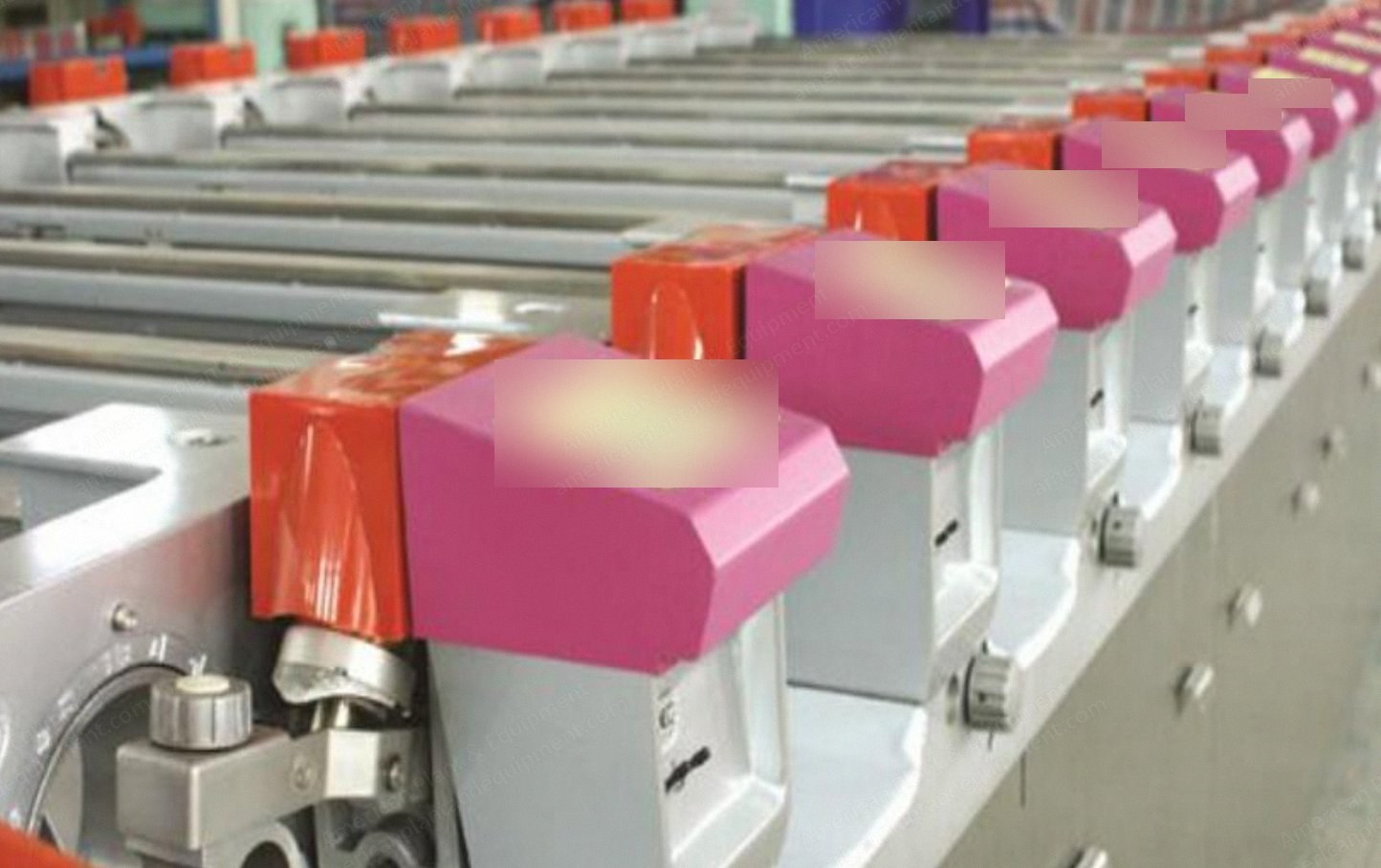
Print machine: consists of machine frame, fabric infeed device, transmission device, squeegee and register device, washing device, blanket correction device, blanket fan device, etc.
Machine frame consists of 200 mm “H” steel and rectangle support pipe, block structure.
Transmission system: main driving roller drives the printing blanket by transducer; each screen head is driven by separate servo motor; synchronous registration is carried out by computer control; relocation of blanket is carried out by 3-rollers; swinging angle of control roller is dragged by motor; positive and negative run or stop signals of motor are sent out by the touch roller starting two nearby switches; touch roller is beside the blanket edge; when blanket installation is right, its edge is in good status; this structure ensures the blanket runs stably and the excursion range can be controlled within 4 mm.
Squeegee and register system: two squeegee ways – blade squeegee and magnet squeegee; pressure force of blade squeegee is from stainless steel’s elasticity; feature is printed line is clear and suitable for limited fabric kinds and width, not suitable for too thick and heavy and too wide fabric; magnet squeegee puts a steel roll inside rotary screen with a line of magnet under fabric; steel roll attaches magnet to make print pressure form; line printed by magnet squeegee is less clear than blade squeegee but suitable for all kinds of fabric with all thickness, weight, and width; telescoping mechanism on support is suitable for different width blade; cylinder controls up and down; device is suitable for both magnet squeegee and blade squeegee; magnet squeegee and blade frame are welded together by stainless steel; both manual and automatic paste supply ways; registration adjusting base’s body is aluminum cast; three adjusting modes: vertical (no limit), horizontal via screw thread structure (adjusting range ±10 mm), diagonal via partiality structure (adjusting range ±5 mm); main body of screen head seat is made of aluminum alloy casting; V-shaped slide rail has six gears to adapt to printing from 640 mm to 1206 mm.
New screen frame: can be lifted on one side for easy maintenance and cleaning; when frame is lifted up, it allows quicker change of friction plate without disassembly and less machine stop time.
Standard rotary screen: thickness of rotary screen is only 0.1 mm; needs tightness to get mechanical strength; function of chuck is to install and tighten rotary screen and deliver rotary force; active chuck manually sets original position of rotary screen; different rotary screen distance and different machine type (left hand or right hand) have different scale; rotary printing machine has function of automatic pre-positioned to set original position without checking scale; W = maximum fabric width; L = screen body length W + 120; L = rotary screen total length W + 210.
Paste supply system: equips each color station with one paste bump; links paste bump to paste delivery pipe to pump paste from paste tank to rotary screen; control switch is installed on side of paste pump, automatic or manual; when printing finishes, paste pump can run in opposite direction to pump back surplus paste in squeegee pipe and paste delivery pipe to tank; under automatic mode, liquid level controller adjusts liquid level inside the screen; paste bump automatically injects paste into rotary screen when liquid level is lower than surface of touch rod; paste bump stops when liquid level reaches height set up.
Washing system: when printing finishes, removes thrum, waste paste, etc. on blanket; pre-washing consists of 2 spraying pipes wash and 2 sponge wipe to remove most remainder and residual paste; main washing consists of 1 spraying pipe wash, 1 brush roller, and 2 T style scrapers arrayed interval; they spray, brush, wash the blanket repeat and remove the water; last spraying pipe’s used water can be recycled into first pre-washing spraying; washing system is fixed with active idler wheel and rail for easy pull out from the machine for cleaning.
Dryer unit and fabric exit: responsible by clients.
Parts Prepared by Client
1 screen head and its bulk.
2 air compressor or station.
3 water, air, oil piping, compressed air piping outside the machine.
4 cable, cable pipe outside the electric cabinet and underground.
5 air exhausting piping of chamber.
6 connection pipe, except flange of radiator of dryer.
7 material for test running.
Electric System and Main Configuration
Electric system and main configuration details are included in the machine specifications and technical features.
Request a Quote
✓
Request sent
Thank you, our team will reply to you shortly.
Direct access to our team
Email American Plant & Equipment
Tell us what you want to buy, source, finance, or sell. A machinery specialist will follow up with you.
✓
Thank you. Your request is with the American Plant and Equipment team.
A machinery specialist will follow up with you.
Machinery updates
Subscribe to our email list
Tell us which industries you follow and we will send you the machines that match.
✓
You are on the list.
We will email you when machines that match your interests come in. Unsubscribe from any message.