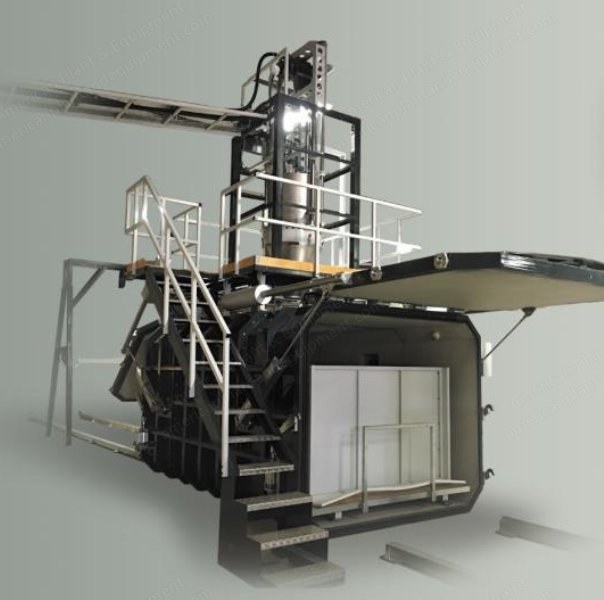
Polyurethane Foam Block Machinery, Pressure Controlled Chamber, Discontinuous System

Description

  1. Overview
    1. Produces conventional foams, viscoelastic (memory) foams, HR foams, 2-component system foams, other special foams, and rigid foams.
    2. For manufacturers of PU foam for mattresses, furniture, clothing, packaging, insulation, and others.
  2. Production Process
    1. Introduce formula (or recall previously recorded formula), start cycle.
    2. Automatic weight of each component, pumping of polyol and catalysts/additives to the reactor for mixing (premix).
    3. Transfer of the premix to its compartment in the transfer and blending at 3000 rpm in the high-speed mixing head.
    4. Automatic weight and pumping of the isocyanate to its compartment in the transfer.
    5. Descent of the transfer to the bottom of the mold, inside the hyperbaric chamber. Mixing of polyol premix and isocyanate in the mixing cone. Opening of the pouring valve with radial pouring of the final mix at the bottom of the mold.
    6. Ascent of the transfer and closing of the hyperbaric chamber. Foam growth under controlled pressure.
    7. The emissions are all extracted because they are contained in a closed stack that goes out through the roof.
  3. Advantages
    1. Discontinuous system: versatile – change formulas and molds between batches to produce the exact quantity needed of different foams.
    2. Discontinuous system: productive – very high output, low cycle times (6 to 10 minutes), production “just in time”, small footprint.
    3. Discontinuous system: efficient – no foam waste when changing formulas, produces rectangular blocks and cylindrical blocks for peeling without waste; excellent reproducibility with the dosing system and software; environmentally friendly, no cleaning water.
    4. Pressure controlled chamber: works with positive and negative pressure.
    5. Pressure controlled chamber: positive pressure increases hardness in foams produced with standard polyols.

    6. Pressure controlled chamber: positive pressure increases density.
    7. Pressure controlled chamber: negative pressure reduces foam hardness for soft and super-soft foams.
    8. Pressure controlled chamber: negative pressure reduces foam density without blowing agents.
    9. Pressure controlled chamber: improves foam qualities such as tensile strength and elongation.
    10. Pressure controlled chamber: gas extraction to outside of the building.
    11. High speed mixing head: improves foam properties by increasing the number of cells and reducing their sizes.
    12. High speed mixing head: blocks with less skin.
    13. High speed mixing head: silkier foam with increased tear resistance.
  4. Components
    1. Pressure controlled chamber: internal dimensions – 4 meters x 2.4 meters x 2 meters.
    2. Pressure controlled chamber: mixing and pouring inside the pressure controlled chamber.
    3. Pressure controlled chamber: prepared to work with positive and negative pressures.
    4. Pressure controlled chamber: electronic pressure controller with automatic pressure control valves.
    5. Pressure controlled chamber: controlled depressurization.
    6. Pressure controlled chamber: opening and closing of the chamber with security valves.
    7. Pressure controlled chamber: robust and durable design.
    8. Transfer: 4 pouring valves for formulated polyol.
    9. Transfer: 4 pouring valves for iso.
    10. Transfer: stainless steel mixing cone for final mixture.
    11. Transfer: radial pouring at the bottom of the mold.
    12. Transfer: capacity for up to 300 kg per batch.
    13. Control panel: control by touchscreen.
    14. Control panel: program of individual and serial blocks production.
    15. Control panel: create and save recipes and production parameters.
    16. Control panel: visualization of the product levels in the tanks.
    17. Control panel: software.
    18. Control panel: PC for remote access and technical support.
    19. Control panel: uninterruptable power supply to avoid power interruption.
    20. High speed mixing head: blender for polyol and additives through high-speed mixing (3000 rpm).
    21. High speed mixing head: possible to add a CO2 stream.
    22. Additives dosing system: 8 additives streams with 80 kg stainless steel tanks.
    23. Additives dosing system: sensor to monitor each tank’s content.
    24. Additives dosing system: dosing by weight.
    25. Additives dosing system: possible to add multiple additives.
    26. Reactor: pre-mixing unit of polyol and additives.
    27. Reactor: equipped with mixer and transfer pump.
    28. Service tanks for polyol and iso: tanks in stainless steel with 1,000 liter, 2,000 liter or 3,000 liter capacity.
    29. Service tanks for polyol and iso: temperature homogenization system with mixer.
    30. Service tanks for polyol and iso: individual temperature control system.
    31. Service tanks for polyol and iso: load cells for weight and dosing of chemicals.
    32. Service tanks for polyol and iso: pump for polyol and magnetic couplings pump for iso.
    33. Service tanks for polyol and iso: possible to add multiple polyol and iso lines (TDI, MDI, visco polyol, HR polyol, polymeric polyol, etc).
    34. The size of the bun produced is decided by the operator. It can be as big as 2 queen beds and around 50 inches tall.
    35. Machine can work with MDI and/or TDI.
  5. Shipping
    1. Requires 2 x 40 foot high cube containers to ship.