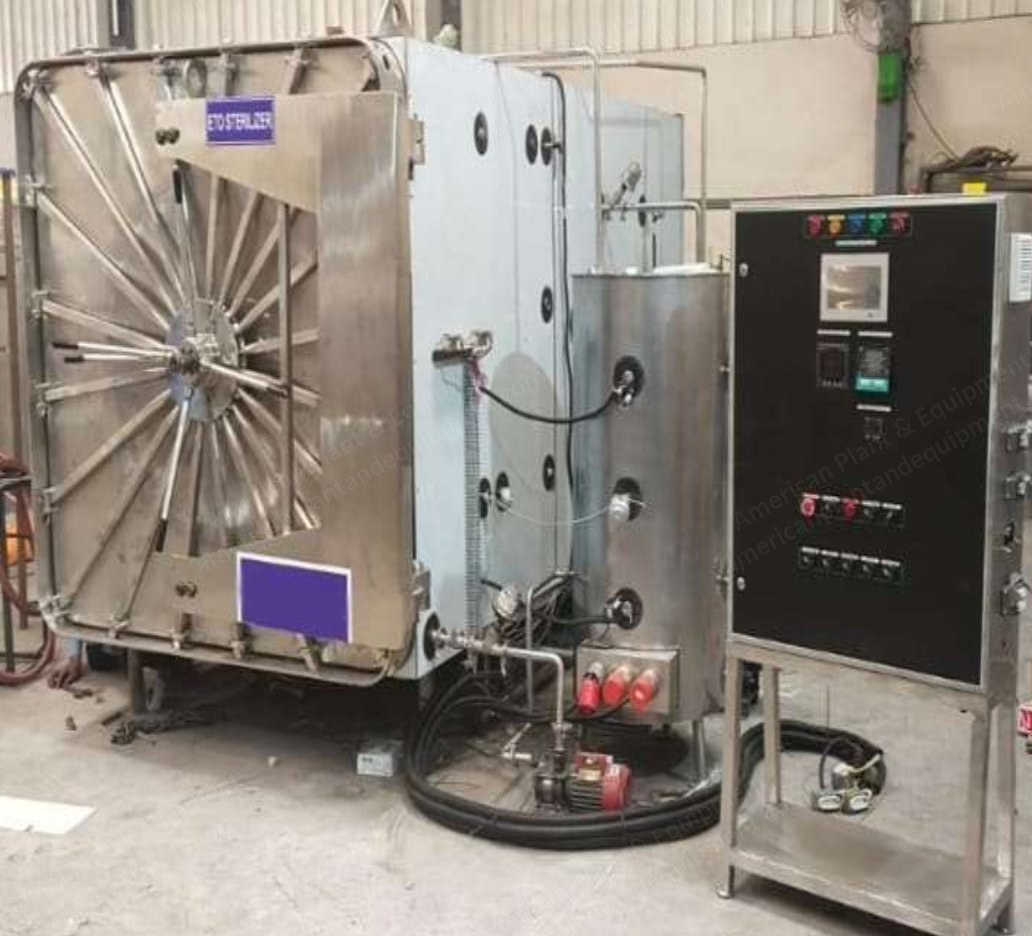
Volume of chamber: chamber is 1820mm x 1820mm x 7250mm (w x h x l).
The chamber is ss and the heating jacket would be manufactured with ss plates.
The chamber is designed to withstand a pressure equal to 20 psig; however, the entire cycle is performed in vacuum.
Chamber is of double door, one in front and one in back, which are manually operated with a radial arm design with a special locking mechanism that prevents the door from being opened after a certain pressure and vacuum.
The back plate is also specially made to withstand the rigors of pressure and vacuum.
Door Gasket
The door gasket is a single piece design – made of molded silicon rubber – chosen for its excellent sealing abilities and long durability.
Chamber Openings
Sufficient numbers of chamber openings are provided on which the various valves and sensors could be mounted.
Welds And Finish
Welds will be free of pits and crevices.
Internal welds are ground smooth and flush with the interior chamber walls.
Chamber Insulation
The chamber is insulated and sheathed with ss 304 creating a pleasing appearance.
The sheathing, combined with the insulation, creates an excellent thermal barrier to reduce the heat load.
The sheathed insulation is impact resistant surface, which prevents damage and allows for easy maintenance.
Chamber Heating System
The chamber is provided with a hot water circulation system through piping around the chamber.
A separate tank – having adequate storage capacity and electric heaters – is provided and the heated water is circulated throughout the chamber periphery with the help of circulation pumps.
Mechanical Equipment And Valves
Sturdy and reliable mechanical components would be used in the assembly of the equipment, including valves, pumps, regulators, etc.
Components are chosen – from reputed suppliers – to simplify calibration, maintenance, replacement and servicing.
Auxiliary Equipment
The following items are part of the ethylene oxide sterilization system.
Vacuum pump: a vacuum pump suction system is provided to evacuate the chamber to 22” hg; the system is prepared to cycle the empty chamber in less than 30 minutes; the vacuum cycle is controlled automatically.
Filtered air inlet / break: an air inlet filter assembly shall be provided to enable vacuum break at the end of the vacuum pulses; the assembly shall include the filter housing that holds a suitable, removable filter cartridge.
Ethylene oxide vaporizer: a specially designed gas evaporator will be provided to ensure that the gas enters the chamber in vapour state only; the gas is conditioned automatically to a predetermined temperature by maintaining the vaporizer temperature at a preset level.
Steam generator and humidity monitoring: a steam generator is provided for humidification purpose; humidity stage is carried out prior to the introduction of ethylene oxide + co2 mixture.
Automation / Electronic Control System
The sterilizer is controlled using dedicated automatic controller that will control the entire cycle of sterilization.
All the parameters required for the cycle can be set and are monitored continuously.
The control system monitors utilities and informs the operator if any utilities are missing or are needed as per the chosen cycle’s requirement.
If any utility that is essential for operation of the selected cycle becomes unavailable, the loss of any monitored parameter during cycle will generate an audible and visual alarm to alert the operator of the malfunction.
Some of the standard features programmed into system: program selection mode – a multiple cycle programs; multiple passwords security system; setting of various parameters to alter cycle with process control limits; in built aeration facility and safety from overpressure and leakage; touch screen controls.
The setup menu allows the operator to select from pre-programmed cycles to establish specific operating parameters for the selected cycle; each cycle consists of segments or phases.
Once all preparations are complete, the operator can then select a cycle; the operator does not need to program the unit again and again for the same cycle; once programmed, the same cycle will be repeated until any modifications are made.
The controller advances the system through the required phases of the selected cycle, as the conditions for each portion are completed; according to the cycle selected, the cycle advances through necessary segments as the conditions to complete each segment are achieved.
During a cycle, the operator display will show the current process values such as chamber temperature and pressure along with other parameters as and where applicable and all the parameter values will be printed.
Also, there is a provision to change over from “auto to manual” operation in case of any unlikely failure of automation system.
A separate chart recording system ensures that even if the auto system were to fail and the cycle were to be operated in manual mode, the batch record can still be maintained, which is an additional feature.
Safety Features
Temperature sensor and electronic pressure sensor linked to the automation would help ensure reliability and failure safe operation.
Constant watch over entries and breaks in diagnostics from automation, which warns the operator, by means of messages on indicator and buzzer.
Physical safety measures include leak protection, over-pressure protection, locked door sensing and pressure lock for door.
Operator protection includes aeration for reduction in residual exposure, guidance for air exhaust system in the chamber and allied rooms; safety instructions and fire safety instructions.
Safety alarm in case of any malfunction, errors, utility failures.
Additional Features
Evacuation of chamber during aeration is programmable; auto – manual changeover is possible in case of failure of auto system; password protection for change of instructions.
After closing the chamber door the entire sterilization operation (evacuation, feeding of gas, degassing and fresh air inlet) will be carried out automatically.
The sterilizer will be controlled using a dedicated automation controller that will control the entire automatic cycle of sterilization; all the parameters like pressure, vacuum, temperature and humidity will be monitored.
The control system monitors the plant utilities, as well as the equipment functions; if any utility essential for operation of the selected cycle becomes unavailable, the loss of any monitored parameter during a cycle will generate an audible and visual alarm to alert the operator of the malfunction.
Multiple program cycle for different applications as required by the customer; password security system.
Setting of various parameters to alter cycles; safety from overpressure and leakage.
The operator starts the cycle and the controller advances the system through these required phases of the sterilization cycle as the conditions for each portion are completed; according to the parameters selected, the cycle advances through the necessary segments as the conditions to complete each segment are achieved.
During a cycle, the operator display will show the current process values such as chamber temperature and pressure along with other set points, wherever applicable and all the parameter values will recorded on a data logger.
Moreover, there is a provision to take a complete cycle in a manual mode in case of failure in the automation system.
Specifications
Capacity: 24 cubic meters
Chamber material: Stainless Steel
Request a Quote
✓
Request sent
Thank you, our team will reply to you shortly.
Direct access to our team
Email American Plant & Equipment
Tell us what you want to buy, source, finance, or sell. A machinery specialist will follow up with you.
✓
Thank you. Your request is with the American Plant and Equipment team.
A machinery specialist will follow up with you.
Machinery updates
Subscribe to our email list
Tell us which industries you follow and we will send you the machines that match.
✓
You are on the list.
We will email you when machines that match your interests come in. Unsubscribe from any message.