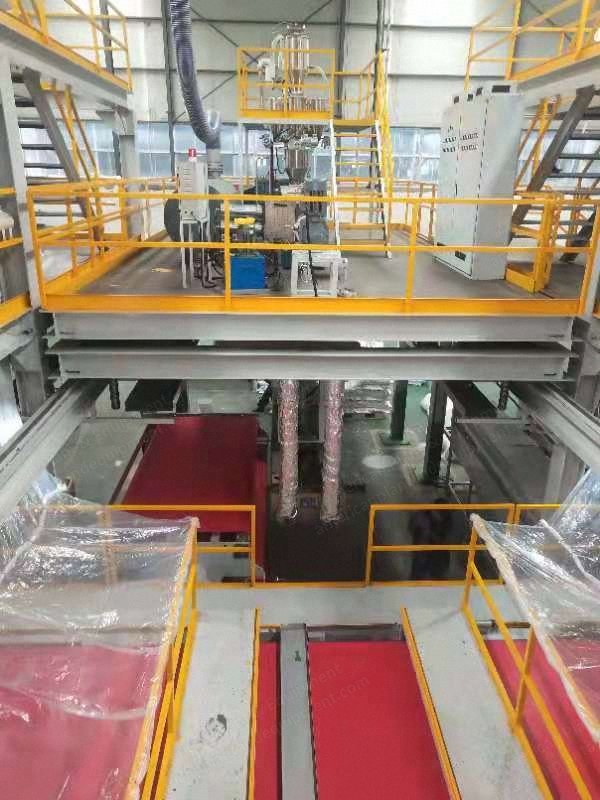
Spunmelt nonwoven fabric production process: pp raw material → spunmelt extruding → filtering → metering → air compressor → spunmelt → web forming → lap winding
Main Technical Parameters
Pp chips requirements: melt index 35-45 g/10 min, fluctuation range of each batch ≤ 1%
Pp chips requirements: melt point 166 °c
Pp chips requirements: ash < 0.15-0.25%
Pp chips requirements: pp color master batch and additive
Melt pp chips requirements: melt index 1200-1800 g/10 min, fluctuation range of each batch ≤ 1%
Melt pp chips requirements: melt point 166 °c
Melt pp chips requirements: ash < 0.15-0.25%
Melt pp chips requirements: pp color master batch and additive
Products width: 2400 mm
Spun bond filament denier: 1.8-2.3 denier
Melt filament denier: 2-5 um
Output: about 5000 ton/8000 hours (based on 45 gsm)
Weight range: 12-60 g/m²
Maximum diameter of fabric per roll: 1500 mm
Design speed: ≤ 350 m/min
Running speed: ≤ 300 m/min
Labor Arrangement
10 workers three shift per day
Carry workers: 3 persons
Salesman: 3-5 persons
Technical engineer: 2 persons
Workplace Dimensions
Size of machine: l x w = 30000 mm x 24000 mm (including air blower room)
Size of machine: l x w = 30000 mm x 15000 mm (air blower not included)
Fore-spinning equipment size: l x w x h = 16000 mm x 12000 mm x 11000 mm
Back spinning equipment size: l x w x h = 14000 mm x 8000 mm x 4500 mm
Suggested workplace size: 50000 mm x 25000 mm (including material and final product warehouse)
Height of workplace: fore-spinning 12000 mm, back spinning 5500 mm
Public Project
Install capacity of the whole production line: about 1250 kw, actual power: 800 kw, main voltage: 3x 380 v, 50 hz
Cycling water: 80 m³/h (25 °c, 0.2-0.35 mpa), water supply ability: 5-10 m³/h
Approval Standard for Equipments
Ss fabric: allowable deviation (%) first class ±8 for 15-45 g/m², ±7 for 60-120 g/m²; final product ±10 for 15-45 g/m², ±9 for 60-120 g/m²
Ss fabric: width deviation (%) first class +2.0, -1.0; final product +2.5, -1.5
Machinery Quality Index, Parameter and Technical Specification
Rim charge auxiliary screw and recycling unit: usage recycle the rim; recycling screw use the alternating frequency converter; screw diameter φ105; screw heating zone number 4 zones
Measuring and mixing device: usage to mix pp and additives as color master batch, antioxidant, fire retardant with certain ratio; screw size φ 150 x 2, maximum feeding ability 480 kg/h x 2; speed 60 rpm; heating zone 7 zones; ac motor; set up high level and low level alarm device, auto control feeding device; electrical motor of screw in mixing device is frequency converting
Screw spinning machine: usage the pp melt go through filter, melt pipe, and metering pump transport the fusant into spinning container and fiber comes out from spinneret; output about 5000 t/year; fiber denier 1.8-2.3 denier; weight range 12-60 g/m²; switched melt filter filter ratings 350, sieve spare 3.5 m²; metering pump and transmission unit pump offering quantity 250cc x 2, frequency converter control synchronous machine; spinning container heating pattern oil heating; melt pipe heating pattern oil heating; slot suction device air pressure 1300 pa, flux 844 m³/h; spinning component hole diameter 0.42 mm, l/d 1:4, material sus431
Stretching device (new model): usage stretching and cooling the fiber; working width 2400 mm; device contains quenching chamber, up stretching channel, down stretching channel, diffuse winder tunnel etc.; using double-side symmetry wind to cool fiber; stretching slit in down stretching device can adjust according to craft requirements; adjust system takes torque motor drive; new type of upper and lower stretcher changes the characteristics of the traditional upper and middle stretcher which cannot be adjusted, making the equipment more regulated to the air volume
Request a Quote
✓
Request sent
Thank you, our team will reply to you shortly.
Direct access to our team
Email American Plant & Equipment
Tell us what you want to buy, source, finance, or sell. A machinery specialist will follow up with you.
✓
Thank you. Your request is with the American Plant and Equipment team.
A machinery specialist will follow up with you.
Machinery updates
Subscribe to our email list
Tell us which industries you follow and we will send you the machines that match.
✓
You are on the list.
We will email you when machines that match your interests come in. Unsubscribe from any message.